
What Is the Current Overview of the Radiation Detection And Monitoring Market?
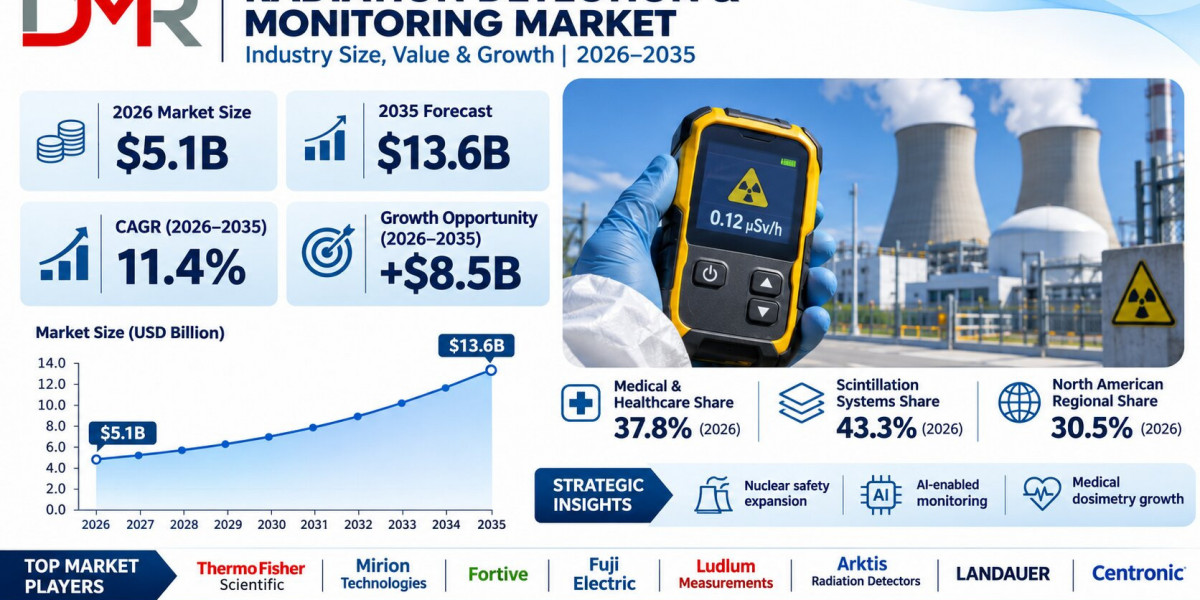
The global Radiation Detection And Monitoring Market is valued at USD 5.1 billion in 2026 and is projected to reach USD 13.6 billion by 2035, expanding at a CAGR of 11.4% from 2026 to 2035, according to Dimension Market Research. The market was valued at USD 4.6 billion in 2025, reflecting increasing demand for radiation safety, occupational exposure monitoring, and advanced detection technologies.
The market includes radiation detectors, personal dosimeters, area monitors, environmental radiation sensors, surface contamination monitors, and radioactive material detection systems. Growing nuclear energy investments, expanding medical imaging and radiotherapy procedures, and stricter radiation safety requirements are encouraging organizations to upgrade their monitoring infrastructure.
Demand is also benefiting from technological improvements in semiconductor detectors, scintillation systems, portable radiation monitoring devices, and AI-enabled monitoring platforms. These developments are improving detection accuracy, operational efficiency, and real-time exposure assessment across healthcare, industrial, nuclear, and homeland security applications.
Request Sample PDF of This Report: https://dimensionmarketresearch.com/request-sample/radiation-detection-and-monitoring-market/
What Is the Expected Value of the Radiation Detection And Monitoring Market by 2035?
The market is expected to experience substantial expansion through 2035, supported by increasing investments in nuclear infrastructure, healthcare safety, and advanced radiation detection equipment. The following statistics highlight its projected development.
- The market reached USD 4.6 billion in 2025.
- The market is valued at USD 5.1 billion in 2026.
- Revenue is projected to reach USD 13.6 billion by 2035.
- The market is forecast to grow at an 11.4% CAGR.
- Detection and Monitoring Solutions held 51.1% in 2026.
- Scintillation Systems accounted for 43.3% in 2026.
- Medical and Healthcare captured 37.8% in 2026.
- North America held a 30.5% regional share in 2026.
- China is projected to reach USD 3.0 billion by 2035.
What Are the Latest Radiation Detection And Monitoring Market Research Findings?
Market research identifies nuclear energy expansion, medical radiation safety requirements, and technological advancements as the major forces shaping industry development. Detection and Monitoring Solutions dominates the product category with a 51.1% revenue share, while Scintillation Systems leads detector technologies with 43.3%. Medical and Healthcare represents the largest end-user category, accounting for 37.8% of revenue in 2026. North America maintains the leading regional position, while Asia Pacific offers significant expansion opportunities through nuclear infrastructure investments in China and India. Semiconductor detectors, AI-enabled monitoring networks, wearable dosimeters, and specialized instrumentation for small modular reactors are emerging as important areas of technological and commercial development.
Why Is the Radiation Detection And Monitoring Market Growing?
The market is growing because radiation monitoring has become an essential requirement across industries that handle radioactive materials or operate radiation-producing equipment. Nuclear power plants require continuous environmental monitoring, area surveillance, and worker dosimetry to maintain safety compliance. Healthcare facilities increasingly depend on radiation measurement instruments to monitor occupational exposure during diagnostic imaging, nuclear medicine, and radiotherapy procedures.
Additionally, government investments in nuclear energy, border security screening, industrial inspection, and emergency preparedness are creating new procurement opportunities. Improvements in portable detectors, wireless monitoring, and automated data management are further supporting equipment replacement and adoption.
What Are the Key Growth Drivers of the Radiation Detection And Monitoring Market?
- Expansion of nuclear power generation and reactor construction.
- Increasing medical imaging and radiotherapy procedures.
- Stricter occupational radiation safety regulations.
- Growing investments in homeland security and border screening.
- Advancements in semiconductor and scintillation detectors.
- Rising demand for portable and wearable radiation monitors.
- Increasing adoption of automated environmental monitoring.
Which Region Is Expected to Witness the Fastest Market Growth?
Asia Pacific is positioned as the fastest-expanding regional market, supported by nuclear power development, government investment, and growing demand for radiation safety infrastructure. China and India are particularly important contributors to regional opportunities. China's market reached USD 1.0 billion in 2026 and is projected to reach USD 3.0 billion by 2035, registering a CAGR of 12.5%.
North America remains the largest regional market, accounting for 30.5% of global revenue, equivalent to approximately USD 1.6 billion in 2026. The United States represents a major contributor, supported by nuclear workforce monitoring, government screening programs, and healthcare applications. Its market is valued at USD 1.1 billion in 2026 and is projected to reach USD 2.4 billion by 2035 at an 8.9% CAGR.
Europe also represents an established market, supported by nuclear safety regulations, environmental monitoring programs, and investments in advanced radiation measurement technologies. Latin America and the Middle East and Africa offer additional opportunities through industrial development, healthcare modernization, and nuclear infrastructure projects.
Which Segment Shows the Highest Growth Potential Within the Radiation Detection And Monitoring Market, and Why?
Detection and Monitoring Solutions
Detection and Monitoring Solutions leads the product category with a 51.1% revenue share in 2026. Its position reflects the widespread requirement for continuous radiation surveillance across nuclear facilities, healthcare institutions, industrial workplaces, and environmental monitoring networks. Organizations increasingly prioritize integrated monitoring solutions that combine detection accuracy, automated reporting, and regulatory compliance.
- Growing installation of permanent radiation monitoring systems.
- Increasing demand for environmental radiation sensors.
- Expansion of personal and workplace dosimetry programs.
Read More About This Market: https://dimensionmarketresearch.com/report/radiation-detection-and-monitoring-market/
Medical and Healthcare
Medical and Healthcare represents the largest end-user category, accounting for 37.8% of market revenue in 2026. Increasing use of diagnostic imaging, nuclear medicine, and radiation therapy is creating sustained demand for occupational dosimeters and radiation monitoring equipment. Healthcare organizations must monitor radiation exposure among medical professionals and maintain patient safety procedures. Expanding radiopharmaceutical applications and hospital modernization are further strengthening demand for reliable radiation measurement and dose management solutions.
- Increasing use of radiation-based diagnostic procedures.
- Growing adoption of occupational dosimetry services.
- Expansion of nuclear medicine and radiopharmaceutical facilities.
Radiation Detection And Monitoring Market Dynamics
What Are the Major Trends Shaping the Market?
Technological innovation is changing how radiation detection and monitoring systems are designed and deployed. AI-enabled analytics, wireless sensors, automated monitoring platforms, and digital dosimetry management are becoming increasingly important. Manufacturers are developing integrated solutions that support real-time exposure tracking and faster responses to abnormal radiation levels. Small Modular Reactor (SMR) development is also creating demand for specialized monitoring and instrumentation platforms. In addition, semiconductor technologies such as silicon carbide and cadmium zinc telluride are attracting attention because of their potential to improve detection performance in compact equipment.
What Are the Future Growth Opportunities in the Radiation Detection And Monitoring Market?
SMR deployment, environmental radiation monitoring, and medical dosimetry represent important future revenue opportunities. China's expanding nuclear infrastructure and India's Nuclear Energy Mission are creating long-term demand for reactor monitoring equipment. India's nuclear capacity target of 100,000 MW by 2047 provides an additional development opportunity for instrumentation manufacturers. Environmental monitoring networks supported by digital infrastructure investments could also encourage adoption of connected radiation sensors. Manufacturers offering modular, cost-effective, and AI-integrated monitoring platforms may benefit from demand among smaller utilities, research institutions, industrial facilities, and emerging healthcare markets.
What Challenges Are Affecting the Market?
Despite strong growth prospects, the industry faces challenges related to regulatory complexity, high equipment costs, and lengthy product qualification processes. Radiation monitoring products must meet applicable national and international safety requirements, which can increase commercialization timelines for manufacturers operating across multiple countries. Nuclear-grade detection systems also require specialized materials, calibration procedures, and technical expertise, creating high initial investment requirements. Smaller utilities, healthcare providers, and industrial operators may face financial barriers when upgrading existing infrastructure. Additionally, dependence on specialized semiconductor materials and detector components can create supply chain constraints and affect manufacturing costs.
Which Country Is Expected to Witness the Fastest Market Growth?
China is expected to demonstrate the fastest growth among the countries with specific forecast figures provided in the report. Its market is projected to increase from USD 1.0 billion in 2026 to USD 3.0 billion by 2035, representing a CAGR of 12.5%. Expanding reactor construction, domestic nuclear energy investments, and increasing regulatory monitoring requirements are supporting this growth. The United States, meanwhile, is projected to grow at an 8.9% CAGR, reaching USD 2.4 billion by 2035.
Who Are the Leading Companies in the Radiation Detection And Monitoring Market?
The competitive landscape includes established manufacturers specializing in radiation detection instruments, personal dosimetry, nuclear safety systems, and environmental monitoring technologies. Leading companies are investing in product innovation, acquisitions, and integrated monitoring solutions to strengthen their market positions.
- Thermo Fisher Scientific
- Mirion Technologies, Inc.
- Fortive Corporation
- Fuji Electric Co., Ltd.
- Ludlum Measurements, Inc.
- Arktis Radiation Detectors Ltd.
- Landauer, Inc.
- Centronic Limited
- Radiation Monitoring Devices, Inc.
- SE International Inc.
- Amray Radiation Protection
Get 10% instant discount on report purchase
Related Reports:
- Surface Roughness Measurement Market
- Testing Inspection Certification For Natural Resources Market
- Testing Inspection Certification For The Metals Minerals Market
- Testing Inspection Certification For The Transportation Market
- Industrial X Ray Inspection Equipment Imaging Software Market
(FAQs)
1. What is the projected global Radiation Detection And Monitoring Market size by 2035?
2. What is the expected CAGR of the Radiation Detection And Monitoring Market during 2026-2035?
3. Which product category dominates the global Radiation Detection And Monitoring Market?
4. Why are scintillation systems widely used in radiation detection and monitoring applications?
5. Which end-user industry accounts for the largest share of the radiation monitoring market?
6. Which region is expected to experience the fastest growth in radiation detection equipment demand?
7. How are semiconductor detectors transforming radiation detection and measurement technologies?
8. What role will small modular reactors play in future radiation monitoring equipment demand?
9. Who are the major manufacturers competing in the global Radiation Detection And Monitoring Market?
10. What are the major challenges and investment opportunities in the radiation monitoring industry?
About Us
Dimension Market Research (DMR) is a global market intelligence and consulting firm delivering data-driven insights that help organizations make informed strategic decisions. With expertise across 12+ industries and global markets, DMR provides syndicated reports, custom research, competitive analysis, white space analysis, and business strategy consulting.
Our research solutions combine analytical rigor, industry expertise, and forward-looking intelligence to identify opportunities, reduce risks, and support sustainable growth. Trusted by clients across diverse sectors, DMR is committed to delivering accurate, actionable insights that enable businesses to navigate evolving market landscapes with confidence.
Contact Us
Phone USA: +17323699777
Phone India: +919310023843
E-mail: enquiry@dimensionmarketresearch.com
Address USA: 957 Route 33, Suite 12 #308, Hamilton Square, NJ-08690
Address India: D44, Sector 6, Noida 201301, India