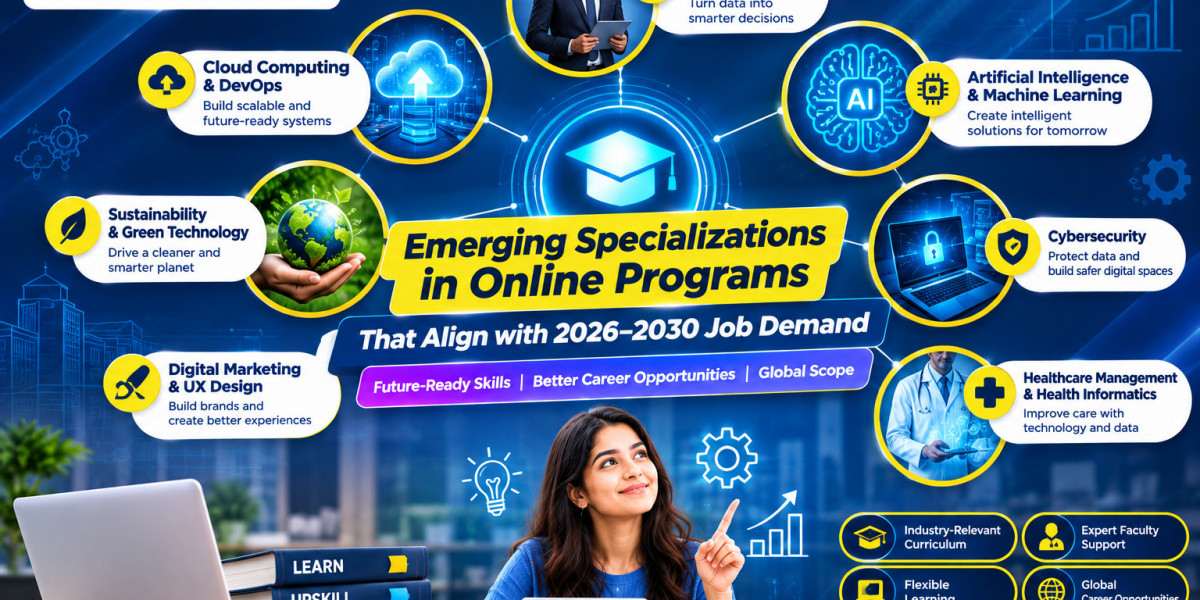

As employment opportunities change, it is increasingly important to develop the right skills for evolving sectors. As artificial intelligence, automation, and data-driven technologies evolve, many industries require new skills. Therefore, current students and working professionals are actively seeking education and training to make the most of increasing career opportunities.
Online learning has become a major factor in developing the skills needed for these opportunities. A Distance Education School provides students with flexible learning options, allowing them to pursue higher education while balancing their personal and professional commitments. Learners can also develop additional skills beyond their existing degrees or areas of interest through online education.
A report from the World Economic Forum (Future of Jobs Report 2025) suggests that up to 170 million new jobs may arise by 2030, whilst 92 million current jobs may be lost. This means demand may shift toward different skills and specialisms within certain industries. If you are considering a career change, or starting or changing your education, consider these predictions and industry trends to choose the right course for you.
Next-Generation Courses for In-Demand Jobs in 2030
Many sectors are already showing signs of growth and creating opportunities for people with the right combination of technical and professional skills. Here are some specializations worth exploring when considering the best courses for future jobs.
1. Artificial Intelligence and Machine Learning
Artificial Intelligence is becoming part of everyday business operations. From customer service chatbots to more sophisticated AI tools that analyze data, assist with medical diagnosis, and even create art, businesses increasingly use AI to improve operations and gain a competitive advantage.
To avoid being left behind, people are taking AI and machine learning courses. The courses cover a wide range of topics from Python and algorithms through to deep learning and data modeling.
Learners can also explore generative AI and agentic AI courses if they're interested in AI-enabled content creation. As AI continues to grow in popularity, there are more and more opportunities in AI development and engineering. Whether you're a complete beginner or have some experience, there are AI courses for beginners that will give you a good grounding in the subject.
2. Data Science and Data Analytics
Businesses generate vast quantities of data, but it's only useful if someone can understand it and make sense of it. That's where the data professionals come in. The Data Science course gives people the skills to understand data and extract useful information to improve business processes.
Data analytics focuses on collecting, cleaning, interpreting, and analyzing data. Students interested in developing careers in this field can explore specialized Online Degree Courses that help them build relevant technical and analytical skills. Career opportunities include Data Analyst, Data Engineer, Business Intelligence Analyst, and Data Scientist.
3. Cyber Security and Cloud Computing
As businesses increasingly rely on digital systems, data may be at risk from cyberattacks, data breaches, and leaks. The cybersecurity course will allow students to learn how to secure networks, identify risks and vulnerabilities, and manage security and risk. The cloud computing course allows students to gain knowledge of cloud systems and virtualization systems. This knowledge can be applied to design secure cloud storage systems and many other services. Jobs in this area (Cloud and Cybersecurity Engineers/Analysts) have great earning potential.
4. Robotics, Automation and Internet of Things
Robotic systems and automated systems are changing how things work in factories and warehouses. Manual processes that previously required significant human effort are now handled by machines and smart systems. In robotics courses, students will learn skills in programming, sensors, and control systems. In Internet of Things courses, students learn about devices used in IoT systems and how they connect and communicate. This topic generally interests engineering students, particularly those who want to put theory into practice. Potential jobs include Robotics Engineers, Automation Specialists, and IoT Developers.
5. Renewable Energy and Sustainability
Industries are investing in renewable energy sources and shifting toward more sustainable business models. This creates opportunities for engineers beyond more traditional engineering roles. Renewable energy courses cover solar technology, wind power, and energy storage. Those interested in the automotive sector can explore online courses on electric vehicles, which cover battery systems and EV technology. Career paths include Renewable Energy Engineers, EV specialists, and Sustainability Consultants.
What Should You Look for in an Online Course?
Ensure that the course provides you with up-to-date knowledge in order to give you an advantage in the job market. Consider:
Up-to-date: Ensure the course content is up to date with current trends in business.
Hands-on: The content should be hands-on (projects, assignments, case studies, etc.)
Well-respected institution: The course should be developed by a well-respected institution. It should have a strong academic focus.
Certification: The course should provide you with certification upon completion.
Time frame: You should be able to complete the course within a reasonable time.
Career development: Choose a course that can aid your development, with career mentoring/placements.
Skills for the Workplace: Choose courses that give you the skills needed so that you can enter the industry immediately.
Conclusion
Different job opportunities will be available in 2026 and 2030. Therefore, it is essential to keep track of trends in specific fields such as Artificial Intelligence, Data Science, Cyber Security, Automation, Renewable Energy, etc. Taking the right specialization courses online can help you find answers to all these questions. But when choosing what to learn, consider what interests you. Although many people may pursue popular courses, they may not be the best choice for you. Also, you must stay updated on new skills and changing industry demands.