
INTRODUCTION
Chemical storage is an important safety consideration when developing a controlled and contamination-conscious fertility laboratory. Proper IVF Lab Design Services should include a carefully planned chemical storage strategy that protects laboratory personnel, preserves the quality of sensitive materials, reduces contamination risks, and supports regulatory compliance. IVF laboratories may use disinfectants, cleaning agents, laboratory reagents, solvents, stains, and other chemicals for routine activities. Each substance can have different storage requirements depending on its chemical properties, compatibility, toxicity, flammability, and manufacturer instructions. Therefore, chemical storage should be considered during the initial laboratory planning stage rather than treated as an additional facility requirement.
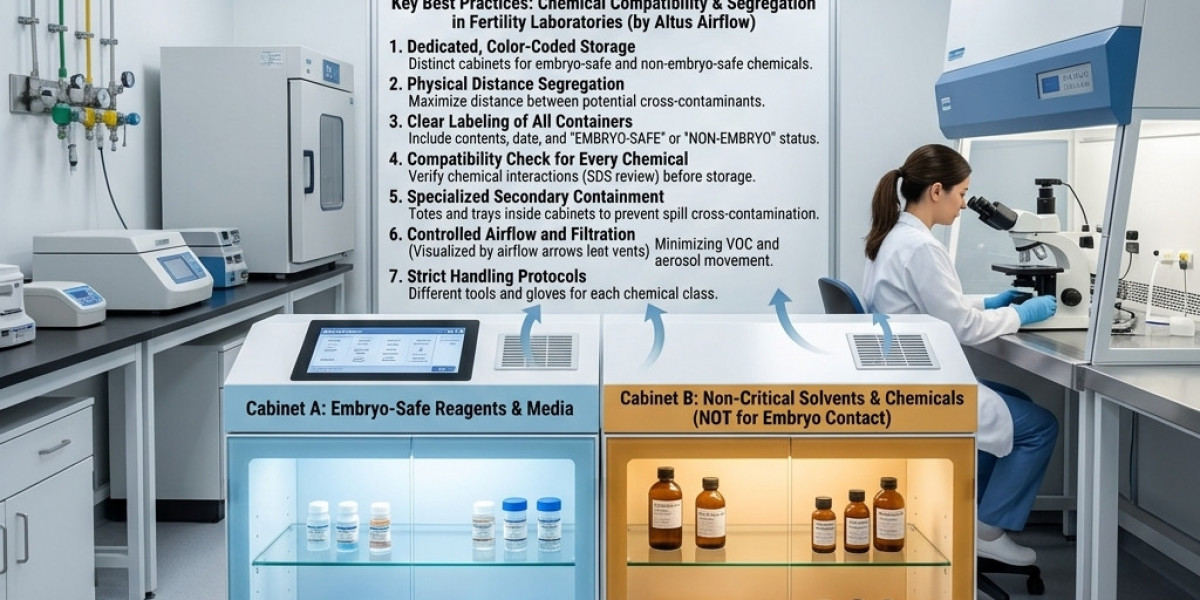
An organized chemical storage system helps prevent accidental exposure, spills, incompatible chemical reactions, and the introduction of harmful vapours into sensitive laboratory areas. In IVF facilities, this is particularly important because embryo culture environments require careful control of potential contamination sources, including volatile organic compounds (VOCs).
1. Identify and Classify All Chemicals Before Planning Storage
The first step is to prepare a complete inventory of chemicals that will be used in the laboratory. Different chemicals require different storage conditions, so placing all containers in one general cabinet may create unnecessary safety risks.
Common chemical categories in IVF facilities may include:
- Disinfectants and surface-cleaning agents.
- Laboratory detergents and detergents used for equipment cleaning.
- Alcohol-based cleaning products.
- Laboratory stains and dyes.
- Reagents and prepared solutions.
- Solvents used for approved laboratory procedures.
- Acids and alkaline substances used for specific applications.
- Maintenance and equipment-cleaning chemicals.
Each chemical should be classified using its Safety Data Sheet (SDS), manufacturer instructions, and applicable hazard communication requirements.
The inventory should record the chemical name, concentration, quantity, hazard classification, storage temperature, compatibility requirements, expiry date, and responsible department. This information helps the design team determine the correct storage locations and cabinet types.
2. Review Safety Data Sheets and Manufacturer Instructions
Safety Data Sheets provide essential information about chemical hazards, handling precautions, storage conditions, and emergency measures.
Before assigning storage locations, laboratory managers and design teams should review the SDS for every chemical. Particular attention should be given to:
Storage temperature: Some substances require room-temperature storage, while others may need refrigeration or protection from excessive heat.
Flammability: Flammable liquids may require approved flammable-storage cabinets and suitable separation from ignition sources.
Chemical incompatibility: Certain substances must be separated because they can react dangerously if mixed or exposed to one another.
Light sensitivity: Some reagents need opaque containers or storage away from direct light.
Moisture sensitivity: Chemicals that react with water or humidity may require dry storage conditions.
Ventilation requirements: Substances that release hazardous vapours may require dedicated storage arrangements or local exhaust ventilation.
Storage instructions should never be based only on a product's appearance or general category. The SDS and supplier guidance should determine the appropriate precautions.
3. Separate Incompatible Chemicals
One of the most important chemical storage precautions is preventing incompatible substances from being stored together.
If incompatible chemicals leak, spill, or come into contact, they may produce heat, fire, toxic gases, or other hazardous reactions.
Common separation considerations include:
- Acids separated from incompatible bases.
- Oxidizing agents separated from flammable and combustible materials.
- Reactive substances stored according to their specific compatibility requirements.
- Chemicals that release toxic gases kept away from substances that may react with them.
- Water-reactive chemicals protected from moisture and incompatible liquids.
A compatibility chart should be developed using SDS information and recognized chemical safety guidance. Storage cabinets should be clearly labelled, and secondary containment should be used where appropriate.
The design should also ensure that chemicals cannot accidentally leak or drain into storage areas containing incompatible substances.
4. Provide Dedicated Chemical Storage Cabinets
Chemical storage should be organized using cabinets suitable for the hazards and quantities of the materials being stored.
Different cabinet types may be required for flammable liquids, corrosive substances, toxic materials, or general laboratory chemicals.
Important considerations include:
Flammable-storage cabinets: Use approved cabinets designed for the relevant flammable-liquid storage requirements. Their location and installation should follow applicable fire-safety requirements.
Corrosive-storage cabinets: Select chemically resistant cabinets with suitable internal finishes and containment arrangements.
General chemical cabinets: Use durable, compatible materials for chemicals that do not require specialized storage.
Refrigerated storage: Where temperature-controlled chemical storage is necessary, use equipment suitable for the chemical hazard. Flammable substances should not be stored in ordinary domestic refrigerators.
Cabinets should be clearly identified, appropriately secured, and positioned so that staff can access materials without obstructing emergency routes or routine laboratory activities.
5. Control VOCs and Protect Embryo Culture Areas
VOCs are an important consideration in IVF laboratory planning because certain airborne chemical compounds may affect sensitive laboratory environments.
Cleaning products, solvents, adhesives, paints, sealants, and some laboratory chemicals can release volatile compounds. Poorly controlled emissions may contribute to indoor air contamination.
Chemical storage should therefore be planned away from critical embryo culture and handling activities wherever possible.
Precautions may include:
- Keeping chemical stores separate from embryo culture rooms.
- Minimizing the quantity of chemicals inside sensitive laboratory areas.
- Selecting low-emission construction and finishing materials.
- Using approved containers with secure closures.
- Providing suitable ventilation for chemical storage areas.
- Avoiding unnecessary use of volatile cleaning agents near sensitive processes.
- Following chemical-specific requirements for local exhaust ventilation.
HEPA filters remove airborne particles but do not generally remove gaseous VOCs. Where chemical vapour control is required, source control, appropriate ventilation, and suitable gas-phase filtration, such as activated carbon or other sorbent media, may be considered following an engineering risk assessment.
Chemical storage ventilation should also be designed so that contaminated air is not recirculated into sensitive laboratory spaces.
6. Maintain Suitable Temperature and Humidity Conditions
Not all chemicals can be stored under the same environmental conditions. Some may degrade when exposed to excessive heat, while others may be affected by moisture or temperature fluctuations.
A well-planned chemical storage area should provide conditions that match the requirements of the stored materials.
The design team should consider:
- Temperature limits specified by manufacturers.
- Humidity restrictions where applicable.
- Protection from direct sunlight.
- Appropriate refrigeration for designated chemicals.
- Monitoring systems for temperature-sensitive storage.
- Alarm arrangements for critical storage deviations.
- Separation of chemicals from heat-producing equipment.
Temperature monitoring may be useful for storage areas containing sensitive reagents. However, monitoring limits should be based on product specifications rather than generic assumptions.
If refrigerated storage is required, the refrigerator should be suitable for the chemical hazards involved and should have an appropriate monitoring and alarm arrangement.
7. Ensure Proper Ventilation and Airflow
Ventilation is essential for chemical storage areas, especially when substances may release hazardous vapours.
The ventilation strategy should be based on the chemical inventory, quantities, hazard classifications, and storage conditions.
Possible design measures include:
Dedicated ventilation: Provide suitable ventilation for chemical storage where required by the risk assessment and applicable safety regulations.
Local exhaust systems: Use suitable extraction arrangements for chemicals that require vapour control.
Airflow separation: Prevent chemical storage air from contaminating embryo culture or other critical laboratory areas.
Exhaust discharge planning: Position exhaust outlets according to applicable safety requirements to prevent contaminated air from re-entering the building.
Maintenance access: Ensure that ventilation components, filters, and extraction equipment can be inspected and maintained safely.
The ventilation design should be reviewed by qualified professionals. A general HVAC system should not automatically be assumed suitable for storing hazardous chemicals.
8. Use Secondary Containment and Spill-Control Measures
Even when chemicals are stored correctly, container damage, leakage, or accidental spills may occur. Secondary containment helps prevent spilled liquids from spreading into surrounding areas.
Suitable precautions include:
- Chemical-resistant trays or bunds.
- Separate containment for incompatible substances.
- Leak-resistant shelving where appropriate.
- Storage cabinets with suitable spill-retention features.
- Clearly identified spill-response equipment.
- Safe arrangements for collecting and disposing of contaminated materials.
Secondary containment materials must be compatible with the chemicals being stored.
Spill kits should be selected according to the hazards present. A general-purpose spill kit may not be appropriate for every chemical. Staff should be trained to identify when a spill can be managed safely and when the area must be evacuated and specialist assistance requested.
9. Plan Safe Storage Layout and Staff Access
The chemical storage area should be easy to identify, access, inspect, and maintain. Poor layout can increase the risk of spills, incorrect handling, and accidental chemical mixing.
Important layout precautions include:
- Providing sufficient storage capacity for planned chemical quantities.
- Avoiding overcrowded shelves and cabinets.
- Keeping heavy containers on lower shelves.
- Preventing storage above eye level where lifting could cause spills.
- Keeping chemicals away from food, personal belongings, and clinical supplies.
- Maintaining clear access to emergency equipment.
- Providing adequate lighting for reading labels.
- Restricting access to authorized personnel.
Storage areas should not obstruct corridors, exits, electrical panels, fire equipment, or emergency routes.
The layout should also support the laboratory's daily workflow. Staff should not need to carry hazardous chemicals through critical embryo handling zones when safer routes are available.
10. Establish Labelling and Chemical Inventory Management
Clear labelling helps prevent chemical misuse and supports safe handling.
Every chemical container should have an appropriate label identifying its contents and relevant hazards. Labels should remain readable throughout storage and use.
A chemical inventory system should record:
- Chemical name and concentration.
- Manufacturer or supplier.
- Date of receipt.
- Opening date where relevant.
- Expiry or retest date.
- Storage location.
- Hazard information.
- Quantity available.
- Responsible department or user.
Labels should follow applicable hazard communication requirements, including the Globally Harmonized System (GHS) where relevant.
Secondary containers should also be labelled appropriately. Chemicals should never be transferred into unmarked bottles or containers that could be mistaken for another substance.
Regular inventory reviews help identify expired, deteriorated, unused, or unnecessary chemicals that should be removed through approved disposal procedures.
11. Prepare Fire Safety and Emergency Response Arrangements
Chemical storage areas should be included in the facility's fire and emergency planning.
Depending on the substances present, precautions may include approved storage cabinets, suitable fire protection, appropriate electrical installations, and safe separation from ignition sources.
Emergency planning should cover:
- Chemical spills and accidental exposure.
- Fire involving stored chemicals.
- Inhalation of hazardous vapours.
- Chemical contact with skin or eyes.
- Container damage and leakage.
- Failure of storage ventilation.
- Unsafe temperature conditions.
Emergency contact information and relevant SDS documents should be readily accessible to authorized staff.
Eyewash stations, safety showers, and suitable fire protection equipment should be provided where indicated by the risk assessment and applicable requirements.
Staff must receive training on evacuation procedures, emergency notifications, spill response, and the correct use of protective equipment.
12. Follow Chemical Waste Disposal Procedures
Expired chemicals, contaminated containers, and unused reagents should not be discarded through ordinary waste routes unless the applicable disposal rules specifically permit it.
A chemical waste management procedure should identify how different waste categories are collected, labelled, stored, and transferred to authorized disposal providers.
Precautions include:
- Separating chemical waste according to compatibility.
- Keeping waste containers closed and appropriately labelled.
- Using compatible containers.
- Avoiding the mixing of unknown chemicals.
- Maintaining waste collection records.
- Following applicable hazardous-waste and local environmental requirements.
Chemical waste should also be distinguished from biomedical waste. The correct disposal route depends on the chemical composition, contamination status, and applicable regulations.
13. Include Chemical Safety During IVF Laboratory Design and Commissioning
Chemical storage requirements should be incorporated into the initial laboratory design process. Retrofitting storage areas later may create workflow problems, ventilation challenges, or unnecessary exposure risks.
A coordinated design process should include:
- Preparing a complete chemical inventory.
- Reviewing SDS documents and storage requirements.
- Developing a chemical compatibility plan.
- Selecting suitable storage cabinets.
- Planning ventilation and exhaust arrangements.
- Providing secondary containment.
- Establishing safe staff access and workflow.
- Defining monitoring and alarm requirements.
- Preparing spill-response and waste procedures.
- Verifying the completed installation before use.
Commissioning should confirm that ventilation systems, storage equipment, monitoring devices, and safety provisions operate as intended.
The laboratory team should also receive training before the facility becomes operational. Procedures must be reviewed periodically as the chemical inventory or laboratory activities change.
Conclusion
Safe chemical storage is essential for protecting IVF laboratory personnel, maintaining organized workflows, and reducing potential contamination risks in sensitive embryo culture environments. Careful chemical classification, compatible storage cabinets, VOC control, suitable ventilation, secondary containment, clear labelling, and emergency planning should all be addressed during the facility design process. Regular inspections, staff training, and documented waste management further strengthen laboratory safety. Altus Airflow supports specialized laboratory infrastructure planning with an emphasis on coordinated engineering, environmental control, and functional facility design.
Frequently Asked Questions (FAQs)
1. Why is chemical storage important in an IVF laboratory?
Chemical storage helps prevent accidental exposure, incompatible reactions, spills, and contamination of sensitive laboratory areas. IVF Lab Design Services should include dedicated storage arrangements based on chemical hazards and manufacturer instructions.
2. Which chemicals require special storage precautions in an IVF lab?
Flammable liquids, corrosive substances, oxidizing agents, toxic chemicals, and temperature-sensitive reagents may require specialized storage. IVF Lab Design Services should classify each substance using its Safety Data Sheet before assigning a storage location.
3. How can VOC contamination from stored chemicals be reduced?
VOCs can be controlled through source reduction, secure containers, appropriate chemical storage ventilation, and suitable gas-phase filtration where required. IVF Lab Design Services should keep chemical storage separate from sensitive embryo culture activities.
4. Should chemical storage be separated from embryo culture rooms?
Where practical, chemical storage should be located outside critical embryo culture areas to reduce potential exposure to vapours and accidental contamination. IVF Lab Design Services should plan dedicated storage and suitable airflow separation.
5. What type of cabinets should be used for IVF laboratory chemicals?
Cabinet selection depends on chemical hazards, compatibility, and storage quantities. IVF Lab Design Services should specify suitable approved cabinets for flammable, corrosive, and other hazardous substances according to applicable safety requirements.
Read Our Previous Blog------>How does Modular Ophthalmic OT Setup Services support the safe operation of multiple incubators?