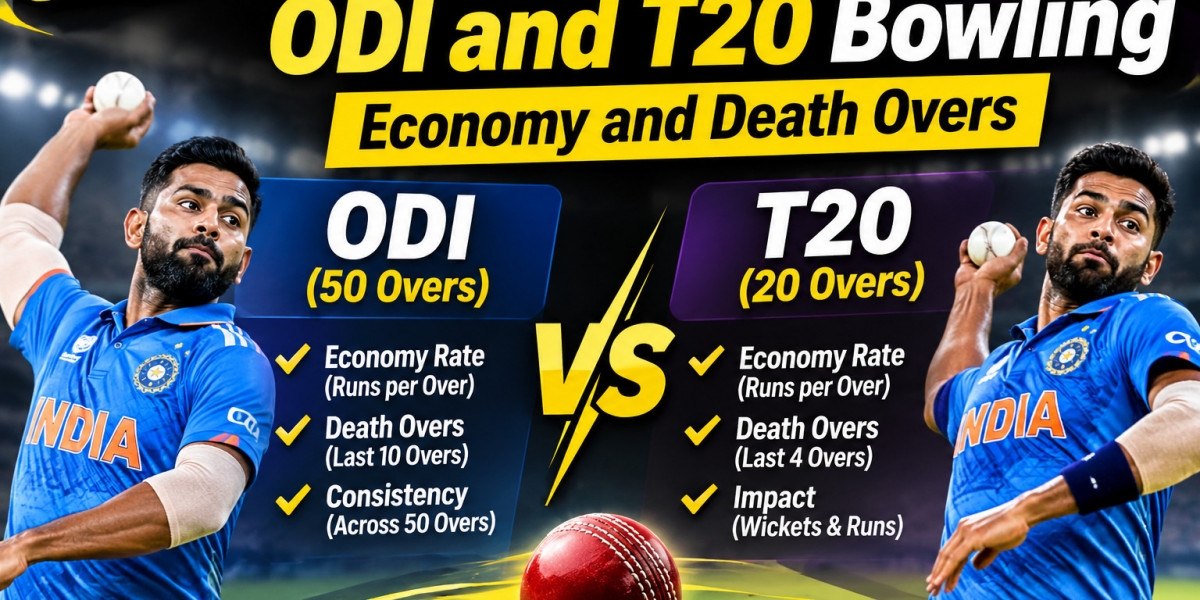

The same bowler can look excellent in a T20 and poor in an ODI, or the other way round, with the same economy. That is not a contradiction. It is a format difference.
In a T20, the death is 5 overs, 16-20. In an ODI, the death is 10 overs, 41-50. In a T20, a bowler bowls 4 overs at most. In an ODI, a bowler bowls 10 overs at most. The economy number is the same formula — runs divided by overs — but the job, the field, and the time to recover are different.
This guide compares the two formats, with the IND vs NZ tour as the worked example: Auckland and Hamilton in the T20Is, and Auckland in the 1st ODI.
The phases are not the same
T20:
- Powerplay: overs 1-6, 2 fielders outside the 30-yard circle.
- Middle overs: overs 7-15, up to 5 fielders outside the circle.
- Death overs: overs 16-20, up to 5 fielders outside the circle.
ODI:
- Powerplay: overs 1-10, 2 fielders outside the circle.
- Middle overs: overs 11-40, 4 fielders outside the circle.
- Death overs: overs 41-50, 5 fielders outside the circle.
That is the first comparison to make. A T20 powerplay is 6 overs. An ODI powerplay is 10 overs. A T20 death is 5 overs. An ODI death is 10 overs. A bowler who is good in the T20 powerplay is not automatically good in the ODI powerplay, because the ODI powerplay lasts four overs longer, with the same field restriction.
The ball is also different in use. In a T20, one new ball is used for the whole innings. In an ODI, two new balls are used, one from each end. That means the ball stays harder for longer in an ODI, and the death overs in an ODI are bowled with a harder ball than the death overs in a T20, where the ball is 16 overs old.
Economy: the same formula, a different meaning
Formula: Economy = Runs conceded / Overs bowled, in true overs, not decimal overs. 9.2 overs is 56 balls, or 9.333 overs.
T20 benchmarks, as guides, not as fixed stats:
- Powerplay: excellent under 6.00, good 6.00-7.00, poor over 8.00.
- Middle overs: excellent under 6.50, good 6.50-7.50, poor over 8.50.
- Death overs: excellent under 8.00, good 8.00-9.00, poor over 10.00.
ODI benchmarks, as guides, not as fixed stats:
- Powerplay: excellent under 4.50, good 4.50-5.50, poor over 6.00.
- Middle overs, overs 11-40: excellent under 4.50, good 4.50-5.00, average 5.00-5.50, poor over 5.50.
- Death overs, overs 41-50: excellent under 7.00, good 7.00-8.50, poor over 9.00.
A T20 economy of 8.00 at the death is good. An ODI economy of 8.00 at the death is also good, but an ODI economy of 8.00 in the middle overs is poor. Judge the economy by the phase, not by the number alone.
A bowler’s economy in a T20 is also more volatile. Four overs is a small sample. One bad over — 20 runs — can take a T20 economy from 6.00 to 11.00. In an ODI, ten overs is a larger sample. One bad over — 20 runs — can take an ODI economy from 4.50 to 6.50, but the bowler has nine more overs to recover. That is why a T20 economy can look extreme, and an ODI economy usually looks steadier.
Death overs: 5 overs vs 10 overs
This is the biggest difference.
In a T20, the death is a sprint. A bowler bowls one over at the death, maybe two, and the innings is over. A set batter can target one bowler, and the bowler has no time to come back. A 32-run over in a T20 can decide the match.
In an ODI, the death is a marathon. A bowler bowls two or three overs at the death, over 10 overs, and the batting side has to pace itself. A set batter can still target one bowler, but the bowling side can change ends, change bowlers, and use the two new balls to keep the ball hard.
Auckland, 4th T20I, 30 October 2026 — the T20 warning:
New Zealand made 259 for 7 in 20 overs at Eden Park. Glenn Phillips made 107 off 49, with 6 fours and 10 sixes, and Michael Bracewell made 65 off 25. Phillips and Bracewell added 115 runs for the fifth wicket off about 40 balls. New Zealand scored 85 runs off the last five overs.
Nitish Kumar Reddy conceded 32 runs in the 16th over — 4, 6, 6, 6, 6 — joint second-most expensive over by an Indian in T20Is. He finished with 1 for 64 in four overs. Mayank Yadav was India’s most successful bowler there, with 3 for 48. Arshdeep Singh took 1 for 38, and Bhuvneshwar Kumar took 0 for 41 in Hamilton, and 0 for 49 and 1 for 50 in Christchurch.
In a T20, that 16th over was the match. Phillips reached his hundred, Bracewell kept hitting, and India had only four overs left to recover. They did not.
Hamilton, 5th T20I, 1 November 2026 — the T20 death did not improve:
New Zealand chased 192 in 18 overs, winning by 7 wickets. Tim Seifert made 93 off 50, Glenn Phillips made 65 not out off 38. India’s bowling was Arshdeep Singh 1 for 40, Varun Chakravarthy 1 for 45, Nitish Kumar Reddy 1 for 19, Bhuvneshwar Kumar 0 for 41, and Prince Yadav 0 for 35.
Hamilton did not show a claimable improvement in death bowling without Jasprit Bumrah. Bumrah was missing for the T20Is and the ODIs, named only for the Tests, with a comeback expected in the India A match at Lincoln. The fifth-bowler overs were expensive, and the chase was finished in 18 overs, before the 20th over.
Auckland, 1st ODI, 4 November 2026 — the ODI death never arrived:
New Zealand were bowled out for 185 in 40.2 overs. India won by 5 wickets by the DLS method, chasing a revised target of 143 in 32 overs. The ODI death overs, 41-50, were never bowled, because New Zealand did not bat that long.
That is the ODI lesson: a good middle-overs performance can remove the death overs altogether. Anshul Kamboj took 2 for 22 in 10 overs, economy 2.20, with two maidens, and was Player of the Match. Axar Patel took 0 for 12 in 5 overs, economy 2.40. Gurnoor Brar took 3 for 44 in 9.2 overs, economy 4.71. Arshdeep Singh took 4 for 70 in 10 overs, economy 7.00, including a 23-run over to Tickner. That 23-run over is expensive, but in an ODI, Arshdeep had nine more overs to take wickets, and he took four. In a T20, a 23-run over in four overs is a different story.
For readers following the tour through cricbet, the comparison to use is this: in a T20, judge the death by the last 5 overs; in an ODI, judge it by the last 10 overs, and by whether the bowling side even reaches them. It is a gaming and betting-related platform, not an official broadcaster, and any betting-related features are for adults only, where legally permitted. Use responsibly and check local rules, as betting law in India varies by state. For live scores, the official broadcast remains Sony Sports Network and Sony LIV in India.
Why the same bowler looks different
Arshdeep Singh:
In Wellington, in the T20Is, Arshdeep took 1 for 33. In Auckland, in the T20I, he took 1 for 38. In Auckland, in the ODI, he took 4 for 70 in 10 overs. His T20 economy looks good, his ODI economy looks poor, but his ODI wickets are four, in a total of 185. Judge Arshdeep by wickets and economy together, in each format, not by economy alone.
Nitish Kumar Reddy:
In Auckland, in the T20I, Nitish took 1 for 64 in four overs, including the 32-run over. In Hamilton, in the T20I, he took 1 for 19. In the ODI, he was benched, with India playing four seamers plus Axar. Nitish at the death in a T20, against a set batter, is a risk. Nitish in the middle overs in an ODI, with a harder ball, is a different job.
Kamboj and Axar:
Kamboj’s 2 for 22 in 10 overs in the ODI, economy 2.20, is a middle-overs and control performance. It would be excellent in a T20 as well, but in a T20 Kamboj would bowl only four overs, not ten. Axar’s 0 for 12 in 5 overs in the ODI, economy 2.40, is a control performance. In a T20, Axar would bowl four overs, and his economy would be judged over four overs, not five.
The fix for the ODIs, from 4 November:
Arshdeep as death lead, Siraj as second death bowler if available, Kuldeep Yadav and Axar Patel taking wickets in the middle overs, overs 11-40, to set up the death, overs 41-50, and Nitish not bowled at the death against a set batter. That fix is an ODI fix, not a T20 fix. In a T20, there are no middle overs 11-40 to set up the death. There are only overs 7-15, and then the death.
How to compare, match by match
1. Split by phase, not by match.
Log a bowler’s economy in the powerplay, middle overs, and death overs separately, in each format. Do not compare a T20 powerplay economy with an ODI middle-overs economy.
2. Use the right sample.
In a T20, four overs is a full spell. In an ODI, ten overs is a full spell. Compare a bowler’s last 5 T20 spells with his last 5 ODI spells, not his last 5 balls.
3. Count wickets with economy.
A bowler with an economy of 7.00 and 4 wickets in an ODI is in form. A bowler with an economy of 7.00 and 0 wickets in a T20 is not. A bowler with an economy of 4.00 and 0 wickets in an ODI is a control bowler. A bowler with an economy of 4.00 and 0 wickets in a T20 is also a control bowler, but he has only four overs to do it in.
4. Watch the ball.
In a T20, the ball is old at the death. In an ODI, the ball is hard at the death, because of the two new balls. A yorker with a hard ball is different from a yorker with an old ball. A slower ball with a hard ball is different from a slower ball with an old ball.
FAQs
What are the death overs in a T20?
Overs 16-20, 5 overs.
What are the death overs in an ODI?
Overs 41-50, 10 overs.
What is a good economy at the death?
In a T20, excellent under 8.00, good 8.00-9.00. In an ODI, excellent under 7.00, good 7.00-8.50. These are guides, not fixed stats.
Why did India’s death bowling look worse in the T20Is than in the 1st ODI?
In Auckland and Hamilton, in the T20Is, New Zealand scored 85 off the last five overs in Auckland, and chased 192 in 18 overs in Hamilton. In Auckland, in the ODI, New Zealand were bowled out for 185 in 40.2 overs, so the ODI death overs were never bowled.
Who is India’s death lead without Bumrah?
Arshdeep Singh, with Siraj as second death bowler if available, in the ODIs. Bumrah is missing for the ODI leg, and is named only for the Tests.
How many overs can a bowler bowl?
Four overs in a T20, ten overs in an ODI.
Verdict
Compare ODI and T20 bowling by phase, not by the headline economy.
A T20 death is 5 overs, a sprint, where one bad over can decide the match. An ODI death is 10 overs, a marathon, where a good middle-overs performance can remove the death altogether. A bowler who looks expensive in a T20 can look controlled in an ODI, and a bowler who looks controlled in an ODI can look expensive in a T20, because the sample, the ball, and the field are different.
For anyone who has seen the phrase King exchange ID in tour coverage, the same rule applies: it is a gaming and betting-related term, not an economy, a death over, or a bowling figure. The comparison is decided by overs, wickets, and phase — 16-20 in a T20, 41-50 in an ODI — not by that phrase.
Watch Wellington on 7 November, and log Arshdeep, Kamboj, Brar and Axar by phase, in the ODI, not by their T20 numbers.