
Thermal Energy Storage Market Overview
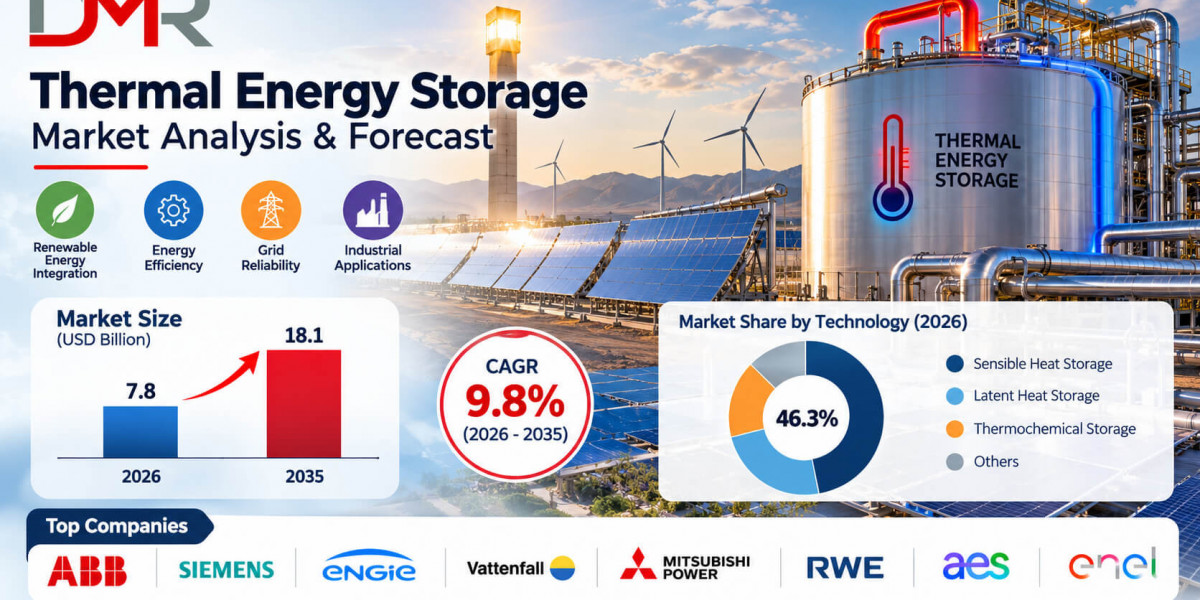
The Thermal Energy Storage Market is gaining importance as utilities, industrial facilities and commercial buildings seek reliable ways to manage energy demand and improve operational efficiency. According to Dimension Market Research, the global market is expected to reach USD 7.8 billion in 2026 and USD 18.1 billion by 2035, expanding at a compound annual growth rate of 9.8% during 2026 to 2035. This growth reflects rising interest in renewable energy integration, grid reliability and efficient heating and cooling infrastructure.
Thermal energy storage systems retain heat or cold for later use, helping balance energy supply and demand. Technologies include sensible heat storage, latent heat storage using phase change materials, and thermochemical storage. These solutions support power generation, industrial process heat, waste heat recovery, district heating and cooling, and building HVAC operations. As energy users focus on cost control and decarbonization, thermal storage is becoming an important component of modern energy management strategies.
Get free sample of this report (with custom data option): https://dimensionmarketresearch.com/request-sample/thermal-energy-storage-market/
Thermal Energy Storage Market Snapshot
● 2026 market value: USD 7.8 billion.
● 2035 forecast value: USD 18.1 billion.
● Forecast CAGR: 9.8% from 2026 to 2035.
● Leading technology: Sensible heat storage.
● Leading storage material: Molten salt.
● Largest application segment: Power generation.
● Leading end-use segment: Utilities and energy.
● Leading region: Europe, with a projected 36.8% share in 2026.
● Fastest-growing regional market: Asia-Pacific.
Thermal Energy Storage Market Research Findings
The market research indicates that thermal energy storage adoption is supported by increasing renewable energy deployment and demand for flexible energy infrastructure. Sensible heat storage is expected to account for 46.3% of the technology segment in 2026, supported by its maturity, scalability and cost advantages. Molten salt is projected to hold 38.7% of the storage material segment, while power generation is expected to account for 44.2% of the application segment. Utilities and energy are projected to represent 48.6% of end-use demand. These estimates highlight the importance of utility-scale energy management, thermal storage materials and renewable power applications in shaping market development.
Why Is the Thermal Energy Storage Market Growing?
The market is expanding because energy producers and consumers need better ways to store surplus thermal energy and use it when demand increases. Solar and wind generation can fluctuate, while industrial facilities require dependable heat supplies. Thermal energy storage helps bridge these gaps by shifting energy use across time, reducing peak demand and improving the utilization of available energy resources.
Demand is also supported by district heating and cooling networks, commercial HVAC optimization and industrial decarbonization initiatives. Improvements in phase change materials, molten salt systems, digital monitoring and thermal battery designs are broadening potential applications. However, upfront installation costs, material performance and project-specific economics remain important considerations for buyers.
Thermal Energy Storage Market Key Growth Drivers
● Growing integration of renewable energy into electricity systems.
● Increasing demand for energy efficiency and lower operating costs.
● Greater emphasis on grid reliability and peak-load management.
● Expansion of district heating and cooling infrastructure.
● Industrial demand for process heat and waste heat recovery.
● Development of advanced thermal storage materials and systems.
Thermal Energy Storage Market Research Scope and Leading Segments
Sensible Heat Storage
Sensible heat storage is expected to lead the technology segment, accounting for 46.3% of the market in 2026. It stores energy by changing a material's temperature without changing its physical phase. Water, molten salt and solid materials such as rocks, concrete and ceramics can be used in these systems. Their established operating principles, scalability and suitability for large installations make them relevant to solar thermal power plants, district heating networks and industrial heat management. Continued deployment will depend on system design, temperature requirements, storage duration and overall project economics.
● Key materials include water, molten salt and solid media.
● Applications include power generation and industrial heat storage.
Power Generation and Molten Salt Storage
Power generation is expected to account for 44.2% of the application segment in 2026, reflecting the role of thermal storage in concentrated solar power and hybrid energy systems. Molten salt is projected to hold 38.7% of the storage material segment, supported by its suitability for high-temperature applications and extended thermal storage. These technologies can retain excess heat and release it when electricity demand rises or renewable generation declines. Their adoption is influenced by plant design, operational requirements, infrastructure investment and the need for dependable energy delivery.
● Molten salt supports high-temperature thermal energy storage.
● Power generation applications can improve dispatch flexibility.
Read more about this market: https://dimensionmarketresearch.com/report/thermal-energy-storage-market/
Thermal Energy Storage Market Dynamics
Trend: Smart and Integrated Energy Systems
Thermal storage systems are increasingly being considered alongside smart grids, digital energy management and automated building controls. Monitoring tools can help operators align storage and discharge schedules with energy demand. Predictive analytics may also support maintenance planning and operational optimization. These capabilities can improve system utilization, although actual results depend on implementation quality and site-specific conditions.
Opportunity: District Heating and Industrial Decarbonization
Expanding district heating and cooling networks creates opportunities for thermal storage in urban infrastructure. Industrial facilities can also use stored heat to reduce waste and improve energy efficiency. Developments in phase change materials and high-temperature thermal batteries may broaden applications across manufacturing, buildings and power systems. Investment decisions will depend on heat demand profiles, infrastructure availability and the financial benefits of energy shifting.
Challenge: High Initial Investment
Thermal energy storage installations can require significant capital for storage vessels, insulation, heat exchangers, control equipment and integration with existing infrastructure. Advanced materials and high-temperature designs may introduce additional technical complexity. Material stability, thermal losses, maintenance requirements and scalability can also influence performance. Vendors and project developers must demonstrate dependable operation and an attractive lifecycle cost to support wider commercial adoption.
Thermal Energy Storage Market Regional and Country Outlook
Regional development reflects differences in energy infrastructure, renewable deployment and industrial demand. The supplied market estimates identify Europe as the leading region, with a projected 36.8% market share in 2026.
● United States: USD 2.0 billion in 2026, with a forecast CAGR of 9.2%.
● Europe: USD 2.9 billion in 2026, with a forecast CAGR of 9.0%.
● Japan: USD 312 million in 2026, with a forecast CAGR of 9.5%.
Europe benefits from district heating infrastructure and decarbonization policies. The United States is supported by renewable energy investment and grid modernization, while Japan's market reflects interest in energy security, waste heat recovery and efficient industrial processes. Asia-Pacific is identified as the fastest-growing region, although no regional market value or CAGR is provided here.
Thermal Energy Storage Market: Key Competitor Companies
The competitive landscape includes technology developers, engineering companies and thermal management suppliers. Companies identified in the research include:
● Siemens Energy AG
● Abengoa S.A.
● Aalborg CSP A/S
● BrightSource Energy Inc.
● CALMAC Corporation
● EVAPCO Inc.
● Baltimore Aircoil Company
● Trane Technologies plc
● SaltX Technology Holding AB
● EnergyNest AS
● Rondo Energy
● Antora Energy
● Brenmiller Energy Ltd.
● Hyme Energy
● Malta Inc.
● Steffes LLC
Competition is shaped by storage efficiency, system reliability, project costs, material innovation and the ability to integrate solutions into existing energy infrastructure.
Get 10% instant discount on report purchase
Explore more reports:
● Europe Solid State Battery Market Trends & Growth
● Battery as a Service Market Trends & Growth
● Battery Management System Market Trends & Growth
FAQ's
1. What is the thermal energy storage market size in 2026?
The thermal energy storage market is expected to reach USD 7.8 billion in 2026, according to Dimension Market Research.
2. What is the thermal energy storage market forecast for 2035?
The global market is projected to reach USD 18.1 billion by 2035, supported by growing demand for efficient energy management.
3. What is the CAGR of the thermal energy storage market?
The market is forecast to expand at a CAGR of 9.8% from 2026 to 2035.
4. What are the main types of thermal energy storage?
The main types are sensible heat storage, latent heat storage using phase change materials, and thermochemical storage.
5. Which technology leads the thermal energy storage market?
Sensible heat storage is expected to lead the technology segment, with a projected 46.3% share in 2026.
6. Which material leads the thermal energy storage market?
Molten salt is projected to lead storage materials, accounting for 38.7% of the segment in 2026.
7. Which application leads the thermal energy storage market?
Power generation is expected to account for 44.2% of the application segment in 2026.
8. Which region leads the thermal energy storage market?
Europe is projected to lead the market with a 36.8% share in 2026.
9. What are the key growth drivers of thermal energy storage?
Renewable energy integration, energy efficiency, peak-load management, industrial heat recovery and district heating support market growth.
10. Who are the key thermal energy storage market companies?
Notable companies include Siemens Energy, Aalborg CSP, BrightSource Energy, Trane Technologies, Rondo Energy and Brenmiller Energy.
Explore the Thermal Energy Storage Market Report
Thermal energy storage is positioned to support changing energy requirements across power generation, industrial operations and heating and cooling infrastructure. Market growth will depend on technology improvements, project economics and the ability to integrate storage into existing energy systems. For detailed market sizing, segment analysis, regional estimates and competitor coverage, consult the full Dimension Market Research report.
About Us
Dimension Market Research (DMR) is a global market intelligence and consulting firm delivering data-driven insights that help organizations make informed strategic decisions. With expertise across 12+ industries and global markets, DMR provides syndicated reports, custom research, competitive analysis, white space analysis, and business strategy consulting.
Our research solutions combine analytical rigor, industry expertise, and forward-looking intelligence to identify opportunities, reduce risks, and support sustainable growth. Trusted by clients across diverse sectors, DMR is committed to delivering accurate, actionable insights that enable businesses to navigate evolving market landscapes with confidence.
Contact Us
Phone USA