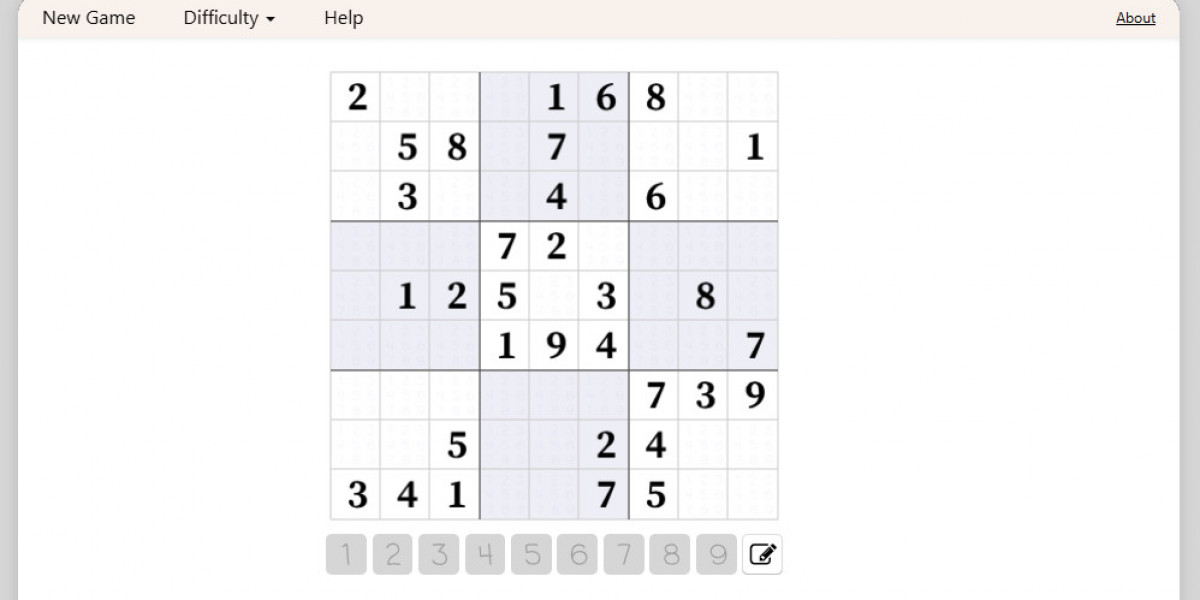

Introduction to Sudoku
Sudoku is a popular logic puzzle that challenges the mind through numbers, concentration, and strategic thinking. Millions of people around the world enjoy Sudoku because it offers a simple set of rules while providing endless opportunities to develop problem-solving skills. Whether played in newspapers, puzzle books, mobile applications, or online platforms, Sudoku remains an engaging activity for beginners and experienced puzzle enthusiasts.
Unlike traditional mathematical exercises, Sudoku does not require advanced calculations or specialized mathematical knowledge. Instead, the game relies on logical deduction, careful observation, and patience. Every puzzle presents a new challenge, encouraging players to analyze available information and identify the correct solution step by step.
Sudoku is suitable for different age groups and skill levels. Easy puzzles help beginners understand the basic rules, while difficult grids require advanced techniques and deeper logical reasoning. By learning how Sudoku works and practicing regularly, players can enjoy a rewarding mental activity that combines entertainment with intellectual development.
What Is Sudoku and How Does It Work?
Sudoku is a number placement puzzle that typically uses a nine-by-nine grid divided into nine smaller three-by-three boxes. The main objective is to fill every empty cell with a number from one to nine while following a specific set of rules.
Each completed row must contain every number from one to nine without repetition. The same requirement applies to every column and every three-by-three box. Some numbers appear in the grid before the puzzle begins, providing clues that guide the solving process.
Although the standard Sudoku puzzle uses numbers, the game does not depend on arithmetic. Players do not need to add, subtract, multiply, or divide numbers to find the answer. Instead, each number represents a symbol that must occupy the correct position according to the rules.
The challenge comes from identifying which numbers can fit into particular cells without creating conflicts elsewhere in the grid. A single correct placement may reveal several new possibilities, allowing the puzzle to gradually become easier.
The Basic Rules of Sudoku
The fundamental rules of Sudoku are straightforward. Every row must contain the numbers one through nine exactly once. Every column must follow the same condition, and each three-by-three box must also contain all nine numbers without duplication.
Players cannot place a number in a cell if that number already appears in the same row, column, or box. These restrictions form the foundation of the puzzle and guide every decision during the solving process.
Understanding these rules is essential before attempting more challenging grids. Once the basic structure becomes familiar, players can begin recognizing patterns and using logical techniques to solve puzzles more efficiently.
Understanding the Sudoku Grid
The standard Sudoku grid contains 81 individual cells arranged into nine rows and nine columns. Each cell belongs to one row, one column, and one three-by-three box.
This structure creates several overlapping relationships between cells. A number placed in one location can affect the available choices in multiple nearby cells. Successful players learn to examine these relationships carefully instead of focusing on isolated parts of the grid.
Recognizing the relationship between rows, columns, and boxes makes it easier to eliminate impossible options and discover the correct number for an empty cell.
How to Solve Sudoku Step by Step
Solving Sudoku becomes easier when players follow a consistent method. Rather than guessing randomly, beginners should start with the most obvious opportunities and gradually move toward more complex deductions.
The first step is to examine rows, columns, and boxes that already contain many numbers. These areas usually have fewer empty cells, making it easier to determine which numbers remain missing.
Next, compare the missing numbers with the existing numbers in each relevant row, column, and box. If only one number can legally occupy a particular cell, that number is the correct choice.
Players can also identify possible candidates for empty cells. For example, if a cell can contain only three or seven without breaking the rules, those two numbers become its candidates. Additional information elsewhere in the grid may eventually eliminate one option.
Use Scanning Techniques
Scanning is one of the simplest and most effective Sudoku strategies. It involves examining rows, columns, and boxes to determine where a missing number can appear.
For example, imagine a three-by-three box that does not contain the number five. If several cells are blocked because their rows or columns already contain five, the remaining eligible cell must receive that number.
Repeated scanning helps players identify certain placements without complicated calculations. This method is particularly useful for easy and medium puzzles, where straightforward deductions often reveal the solution.
Identify Naked Singles and Hidden Singles
A naked single occurs when an empty cell has only one possible candidate. Because every other number would violate a Sudoku rule, the remaining candidate must be correct.
A hidden single occurs when a number can occupy only one cell within a particular row, column, or box, even though that cell may initially have several candidates.
Both techniques are essential for efficient solving. Naked singles focus on the possibilities available within one cell, while hidden singles examine the possible positions for a specific number across a larger area.
Advanced Sudoku Strategies for Better Results
As Sudoku puzzles become more difficult, basic scanning may not provide enough information to complete the grid. Advanced techniques help players recognize relationships between candidates and eliminate possibilities through logical reasoning.
One useful method is the naked pair technique. When two cells in the same row, column, or box contain exactly the same two candidates, those candidates must occupy those two cells in some order. Consequently, the same numbers can be removed from other cells within that shared area.
Another technique is the pointing pair. If a particular number can appear in only two cells within a three-by-three box and both cells belong to the same row or column, that number cannot appear elsewhere in the corresponding row or column outside the box.
More advanced players may also explore X-Wing patterns, which use relationships between rows and columns to eliminate candidates. These methods require careful observation, but they can make challenging puzzles significantly more manageable.
Avoid Guessing When Possible
Guessing may seem like a quick way to complete a difficult Sudoku puzzle, but it can create confusion when an incorrect choice affects several later decisions. Logical deduction provides a more reliable approach because every placement follows directly from the available evidence.
When progress stops, players should review candidate numbers, inspect overlooked rows and boxes, and search for patterns that were not immediately obvious. Taking a short break can also help reveal opportunities that were previously missed.
Benefits of Playing Sudoku Regularly
Sudoku offers several potential cognitive and recreational benefits. The puzzle encourages sustained attention because players must examine multiple relationships while keeping track of available candidates.
Regular practice can also provide opportunities to exercise logical reasoning, pattern recognition, and systematic problem-solving. These skills are useful during puzzle solving and may support other activities that require careful analysis.
Sudoku can serve as a relaxing alternative to passive entertainment. Focusing on a puzzle creates a clear short-term objective and offers a satisfying sense of progress when difficult sections become easier to solve.
However, Sudoku should not be considered a guaranteed method for improving intelligence or preventing cognitive decline. Research on brain training does not establish that success in one puzzle automatically produces broad improvements in every mental ability. The most reliable benefit is the opportunity to practice focused reasoning in an enjoyable format.
Sudoku for Beginners and Experienced Players
Beginners can start with easy puzzles that contain many clues and require only basic scanning. As confidence increases, medium-level grids introduce more complex interactions between rows, columns, and boxes.
Experienced players may prefer difficult or expert puzzles that require candidate notation and advanced elimination techniques. Choosing an appropriate difficulty level helps maintain motivation without making the experience unnecessarily frustrating.
Online Sudoku games often provide several difficulty settings, making it easy to find puzzles that match individual preferences and experience.
Where to Play Sudoku Online
Online Sudoku platforms make the game accessible through computers, tablets, and smartphones. Many websites offer free puzzles, adjustable difficulty levels, digital note-taking tools, and error-checking features.
Some platforms include daily challenges, timed games, hints, and progress tracking. These features can make regular practice more convenient while allowing players to experiment with different solving methods.
When choosing an online Sudoku platform, look for a clear interface, readable numbers, responsive controls, and puzzles that match the desired difficulty level. Beginners may benefit from optional hints, while experienced players may prefer a clean grid without automatic assistance.
Printed Sudoku puzzles remain another excellent option for people who enjoy solving problems on paper. Writing candidate numbers by hand can encourage a deliberate solving process and provide a welcome break from digital screens.
Conclusion
Sudoku is a timeless logic puzzle that combines simple rules with challenging problem-solving opportunities. Its structured grid encourages players to analyze patterns, eliminate impossible choices, and develop solutions through careful reasoning.
From basic scanning to advanced techniques such as naked pairs and X-Wing patterns, every stage of Sudoku offers something new to learn. Regular practice can make the solving process more familiar, improve efficiency, and provide an enjoyable mental challenge.
Whether played online or on paper, Sudoku offers an accessible activity for beginners and experienced enthusiasts alike. By understanding the rules, choosing suitable puzzles, and relying on logical deduction, anyone can develop a more confident approach to solving Sudoku and enjoy the satisfaction of completing each grid.