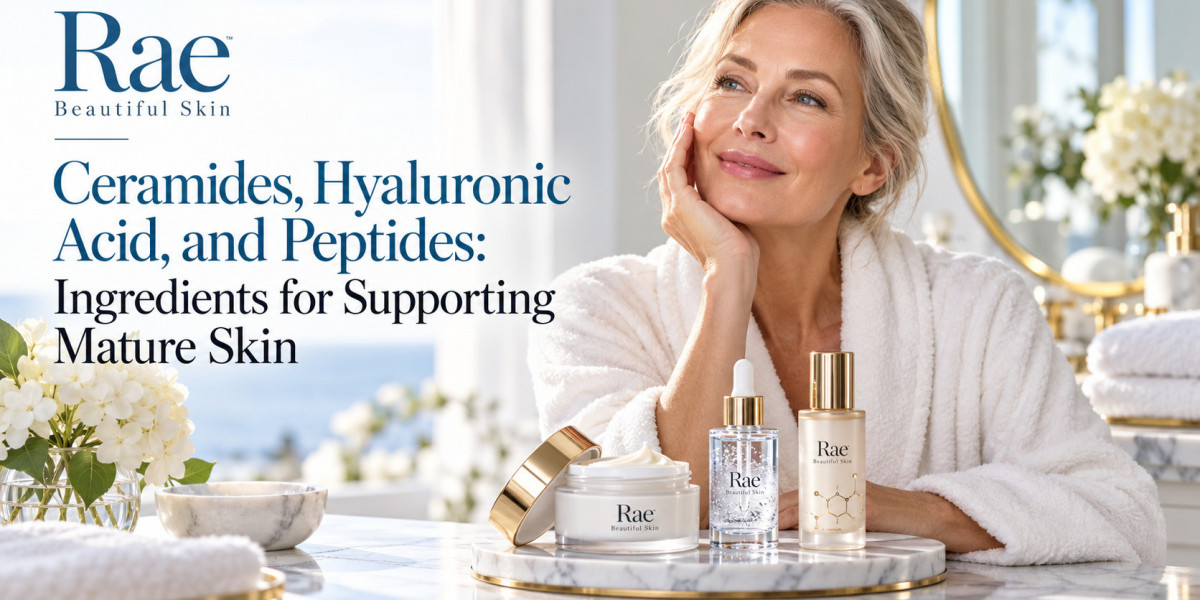

As skin matures, its needs often become more complex. Dryness may become more noticeable, skin can feel less supple, and fine lines or changes in texture may become more visible. While aging is a natural process, choosing skincare ingredients that support hydration, the skin barrier, and a smoother-looking complexion can make a meaningful difference in how mature skin looks and feels.
Three ingredients frequently found in modern skincare formulas are ceramides, hyaluronic acid, and peptides. Each supports the skin in a different way. Ceramides help reinforce the skin barrier, hyaluronic acid attracts and holds moisture, and peptides are commonly used in formulas designed to support firmer, smoother-looking skin.
Understanding what these ingredients do can make it easier to build a mature skincare routine without turning your bathroom shelf into a chemistry department.
What Happens to Skin as It Matures?
Skin changes gradually over time. These changes are influenced by genetics, sun exposure, lifestyle, hormones, environment, and everyday skincare habits.
As skin matures, several visible changes may occur, including:
Increased dryness
A rougher or less even texture
Reduced appearance of firmness
More visible fine lines
Dullness
Greater sensitivity to environmental stress
A weaker-feeling moisture barrier
One reason dryness becomes more common is that the skin may produce fewer natural oils and retain moisture less efficiently than it did earlier in life.
At the same time, structural components that contribute to the appearance of firmness and elasticity also change with age.
A good mature skincare routine therefore does not need to focus only on wrinkles. Supporting hydration, barrier function, comfort, texture, and overall skin appearance can be equally important.
That is where ingredients such as ceramides, hyaluronic acid, and peptides become useful.
What Are Ceramides?
Ceramides are naturally occurring lipids, or fats, found in the outermost layer of the skin.
They are an important part of the skin barrier, which helps prevent excessive water loss while protecting the skin from environmental factors.
A simple way to imagine the skin barrier is to think of skin cells as bricks and lipids such as ceramides as the material holding those bricks together.
When the barrier is working well, skin is better able to retain moisture and maintain a smoother, more comfortable surface.
Why Ceramides Can Be Helpful for Mature Skin
As skin matures, its natural lipid composition can change. This may contribute to dryness, roughness, and increased sensitivity.
Skincare products containing ceramides are commonly used to support the skin's barrier and improve moisture retention.
Potential cosmetic benefits of ceramide-containing products include:
Helping reduce moisture loss
Supporting the skin barrier
Improving the feeling of dryness
Helping skin feel softer and smoother
Supporting a more comfortable complexion
Ceramides are particularly useful for people whose mature skin feels tight, flaky, rough, or easily irritated.
They are commonly found in moisturizers, creams, lotions, and barrier-supporting serums.
What Is Hyaluronic Acid?
Hyaluronic acid is a naturally occurring substance found throughout the body, including in the skin.
In skincare, hyaluronic acid is mainly valued for its ability to attract and hold water.
It acts as a humectant, meaning it helps draw moisture toward the surface layers of the skin.
This can temporarily improve the appearance of plumpness and make fine dehydration lines look less noticeable.
Despite the word "acid" in its name, hyaluronic acid is not an exfoliating acid like glycolic or salicylic acid.
It is primarily a hydrating ingredient.
Why Hyaluronic Acid Works Well for Mature Skin
Hydration plays an important role in how mature skin looks.
When skin is dehydrated, it may appear:
Duller
Rougher
Less supple
More lined
Less radiant
By increasing surface hydration, hyaluronic acid can help the complexion look smoother and more refreshed.
It can be especially useful in lightweight serums because it provides hydration without necessarily creating a heavy or greasy feeling.
However, hyaluronic acid usually works best as part of a broader moisturizing routine rather than being used alone.
After applying a hyaluronic acid serum, using a moisturizer can help support moisture retention.
Different Forms of Hyaluronic Acid
You may notice skincare products using terms such as:
Hyaluronic acid
Sodium hyaluronate
Hydrolyzed hyaluronic acid
Multi-molecular hyaluronic acid
These forms differ in molecular size and formulation behavior.
Some formulas combine different forms of hyaluronic acid to hydrate different levels of the skin's surface.
Consumers do not necessarily need to choose a product based solely on molecular weight. The overall formulation matters just as much as the individual ingredient.
A well-formulated serum containing hyaluronic acid, supportive humectants, and barrier-friendly ingredients may provide better results than selecting a product simply because it advertises a particular molecular size.
What Are Peptides?
Peptides are short chains of amino acids.
Amino acids are the building blocks of proteins, including proteins that are naturally present in the skin.
In cosmetic skincare, peptides are often included in formulas designed to support smoother, firmer, or more youthful-looking skin.
Different peptides may perform different roles depending on their structure and formulation.
This means "peptides" should not be treated as one single ingredient.
There are many different types.
Why Peptides Are Popular in Mature Skincare
As skin ages, changes in collagen, elastin, hydration, and barrier function can contribute to visible signs of aging.
Peptide-containing products are commonly marketed to help improve the appearance of:
Fine lines
Skin firmness
Texture
Smoothness
Overall skin quality
Peptides are often appealing to people who want to support mature skin without immediately relying on stronger active ingredients.
They can also be included alongside hydrating ingredients, antioxidants, and moisturizers.
Peptides generally work best as part of a consistent skincare routine rather than as a quick fix.
As with most skincare ingredients, visible improvements usually depend on the formulation, concentration, skin condition, and regular use.
Ceramides vs. Hyaluronic Acid vs. Peptides
These three ingredients are sometimes discussed together, but they have different primary roles.
Ingredient | Main Role | Best Known For |
Ceramides | Barrier support | Helping reduce moisture loss and dryness |
Hyaluronic Acid | Hydration | Helping skin appear plumper and smoother |
Peptides | Skin-conditioning and appearance support | Supporting firmer, smoother-looking skin |
Rather than choosing only one, many mature skincare routines can benefit from using all three.
They are complementary rather than competing ingredients.
Can You Use Ceramides, Hyaluronic Acid, and Peptides Together?
Yes. These ingredients are generally easy to combine within the same skincare routine.
In fact, many modern serums and moisturizers already contain combinations of humectants, peptides, and barrier-supporting ingredients.
A simple routine might look like this:
Step 1: Gentle Cleanser
Begin with a mild cleanser that removes makeup, sunscreen, and impurities without leaving the skin feeling stripped.
Mature skin often benefits from gentle cleansing rather than aggressive foaming formulas.
Step 2: Hyaluronic Acid Serum
Apply a hydrating serum containing hyaluronic acid to clean skin.
Many people prefer applying it while the skin is slightly damp.
Step 3: Peptide Serum
Apply a peptide serum if it is not already included in your hydrating product.
Depending on the formulation, hyaluronic acid and peptides may already be combined in a single serum.
Step 4: Ceramide Moisturizer
Follow with a moisturizer containing ceramides or other barrier-supportive lipids.
This helps lock in hydration and reduce moisture loss.
Step 5: Sunscreen in the Morning
During the daytime, finish with broad-spectrum sunscreen.
Sun protection remains one of the most important steps in any routine focused on maintaining healthier-looking mature skin.
Should Hyaluronic Acid Be Applied Before Peptides?
In most routines, product texture matters more than ingredient category.
A practical rule is to apply products from thinnest to thickest.
For example:
Cleanser
Lightweight hydrating serum
Peptide serum
Moisturizer
Sunscreen
If your peptide serum is thinner than your hyaluronic acid product, the order can be reversed.
You also do not need multiple separate serums if one well-formulated product already contains both ingredients.
More products do not automatically produce better skin. Human beings remain oddly committed to learning this lesson the expensive way.
What Other Ingredients Complement These Three?
Ceramides, hyaluronic acid, and peptides can work alongside several other skincare ingredients.
Niacinamide
Niacinamide is a form of vitamin B3 commonly used to support the skin barrier and improve the appearance of uneven tone, pores, and texture.
Glycerin
Glycerin is another effective humectant that helps attract water to the skin.
It is often used alongside hyaluronic acid.
Squalane
Squalane is an emollient that can help soften dry skin and improve comfort.
Antioxidants
Ingredients such as vitamin C, vitamin E, and various botanical antioxidants are often included in skincare formulas designed to help protect against environmental stress.
Retinoids or Retinol
Retinol is commonly used in anti-aging skincare because it can support smoother texture and reduce the appearance of fine lines over time.
However, it can sometimes cause dryness or irritation, particularly when introduced too quickly.
Pairing retinol with barrier-supporting moisturizers containing ceramides may help maintain skin comfort.
Do Mature Skin Routines Need Many Active Ingredients?
Not necessarily.
A mature skincare routine can be highly effective while remaining relatively simple.
A basic routine may include:
Morning
Gentle cleanser
Hydrating or peptide serum
Moisturizer
Broad-spectrum sunscreen
Evening
Gentle cleanser
Hydrating serum
Peptide serum or another targeted treatment
Ceramide-rich moisturizer
Additional products can be introduced based on specific concerns, but there is no need to use every trending ingredient at once.
Introducing several strong products simultaneously can make it difficult to determine what is actually helping or irritating the skin.
How Long Does It Take to Notice Results?
The timeline depends on the ingredient and the benefit you are looking for.
Hydrating ingredients such as hyaluronic acid may make the skin feel softer or look temporarily plumper relatively quickly.
Barrier-supporting ingredients such as ceramides may improve the feeling of dryness and comfort with consistent use.
Changes associated with peptides usually require more patience.
Skincare should generally be evaluated over weeks rather than days.
Consistency tends to matter more than constantly switching between products.
How to Choose Products for Mature Skin
When shopping for mature skincare, consider the entire formula instead of focusing only on one highlighted ingredient.
Look for products that provide a combination of:
Humectants for hydration
Emollients for softness
Barrier-supporting lipids
Skin-conditioning ingredients
Antioxidants where appropriate
People with sensitive skin may also prefer fragrance-free or minimally fragranced products.
Patch testing a new formula before applying it widely can be helpful, particularly when your skin reacts easily.
Common Mistakes to Avoid
Using Hyaluronic Acid Without a Moisturizer
A hydrating serum can be useful, but mature or dry skin often needs a moisturizer afterward.
Ignoring the Skin Barrier
Constant exfoliation or overuse of active ingredients can leave skin uncomfortable and dry.
Barrier-supportive products should remain part of the routine.
Expecting Peptides to Work Overnight
Peptides are not instant wrinkle erasers. Consistent use is more realistic than expecting dramatic changes within days.
Skipping Sunscreen
A sophisticated anti-aging routine without daily sun protection is rather like buying expensive furniture and leaving it outside in the rain.
Broad-spectrum sunscreen helps protect the skin from UV exposure that contributes to visible skin aging.
Which Ingredient Is Most Important for Mature Skin?
There is no single ingredient that every person needs most.
The right choice depends on what your skin is currently lacking.
If your skin feels dry, tight, or easily irritated, ceramides may deserve particular attention.
If your skin looks dehydrated or less plump, hyaluronic acid can provide useful hydration.
If your concern is fine lines, texture, or reduced firmness, a peptide-containing serum may fit well into your routine.
For many people, combining the three provides a more complete approach.
Final Thoughts
Ceramides, hyaluronic acid, and peptides each support mature skin from a different angle.
Ceramides help maintain the skin barrier and reduce moisture loss.
Hyaluronic acid supports hydration and can make the skin appear smoother and more plump.
Peptides are commonly included in anti-aging formulas designed to support firmer, smoother-looking skin.
Rather than searching for one miracle ingredient, mature skincare usually benefits from a balanced routine built around hydration, barrier support, targeted treatments, and daily sun protection.
The most effective routine is not necessarily the most complicated one. It is the one you can use consistently while keeping your skin comfortable, hydrated, and well supported with RAE Beautiful Skin.
by improving hydration, barrier function, smoothness, and a firmer-looking complexion.







