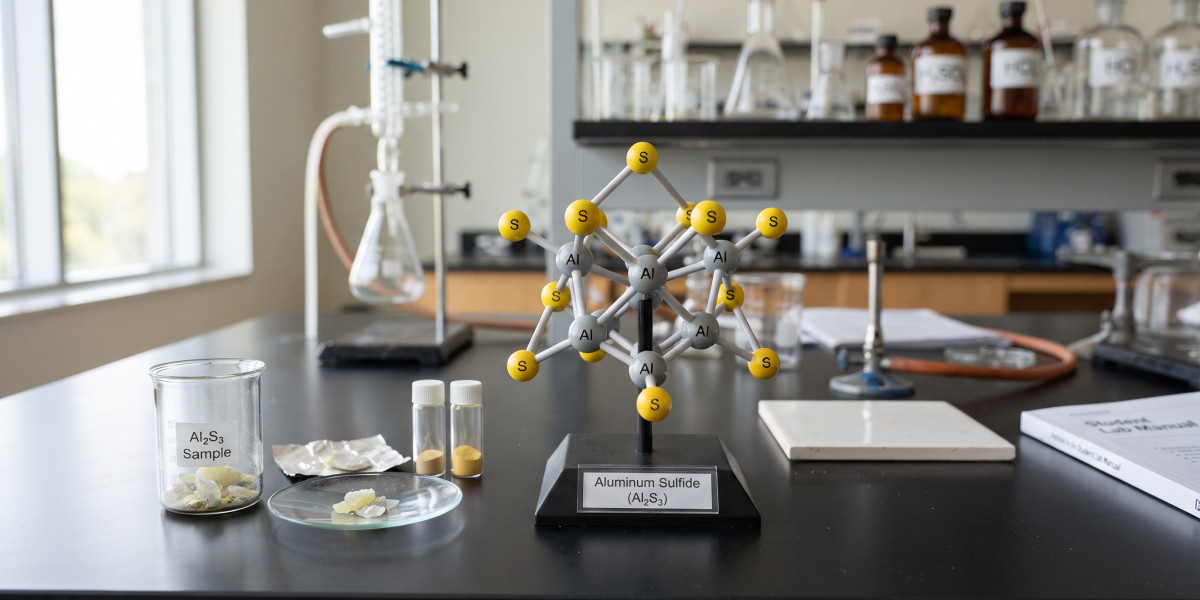

The chemical formula for aluminum sulfide is Al₂S₃, which represents a compound made from aluminum and sulfur. Aluminum sulfide is an important inorganic compound that can be studied in basic chemistry, inorganic chemistry, materials science, and laboratory applications. Understanding its formula helps explain how aluminum and sulfur combine, how the compound is formed, and why its chemical behavior differs from the elements that make it. The formula also provides useful information about the relative composition of the compound and the way its constituent elements are represented in chemical notation.
What Is Aluminum Sulfide?
Aluminum sulfide is an inorganic compound formed when aluminum combines chemically with sulfur. It is commonly described as a sulfide of aluminum and is represented by the chemical formula Al₂S₃. The compound has properties that are different from those of pure aluminum and elemental sulfur because chemical bonding creates a new substance with its own structure and behavior. Aluminum sulfide is mainly encountered in chemistry education, laboratory discussions, inorganic chemistry, and specialized chemical applications where sulfide compounds are relevant.
What Is the Chemical Formula for Aluminum Sulfide?
The chemical formula for aluminum sulfide is Al₂S₃. The symbol Al represents aluminum, while the symbol S represents sulfur. The subscripts show the relative proportion of aluminum and sulfur present in the compound's formula. This means the formula describes a chemical composition containing aluminum and sulfur in a specific ratio. Learning how to interpret this formula is useful because chemical formulas provide a concise way to communicate the elemental composition of substances.
Why Is the Formula Al₂S₃?
The formula Al₂S₃ is based on the charges commonly associated with aluminum and sulfide ions. Aluminum generally forms a positively charged ion with a charge of three, while sulfur can form a sulfide ion with a charge of negative two. To create an electrically neutral compound, the positive and negative charges must balance. The combination of aluminum and sulfide therefore produces the formula Al₂S₃, where the total positive charge balances the total negative charge.
How to Understand the Formula of Aluminum Sulfide
Understanding Al₂S₃ becomes easier when the symbols and subscripts are considered separately. The chemical symbol Al identifies aluminum, while S identifies sulfur. The subscript associated with aluminum indicates that two aluminum units are represented, while the subscript associated with sulfur indicates three sulfur units. The formula does not simply describe a physical mixture of aluminum and sulfur. Instead, it represents a chemically bonded compound with a defined composition.
How Is Aluminum Sulfide Formed?
Aluminum sulfide can form through a chemical reaction between aluminum and sulfur under suitable conditions. During this process, the elements undergo a chemical transformation and form a new compound. The reaction is commonly used as an educational example because it demonstrates how elements can combine to create a substance with properties different from those of the original materials. The formation of aluminum sulfide also provides a useful illustration of charge balance and chemical formula writing.
Chemical Reaction of Aluminum and Sulfur
The reaction between aluminum and sulfur produces aluminum sulfide when appropriate reaction conditions are provided. In chemical notation, the balanced reaction can be represented as 2Al + 3S → Al₂S₃. This equation shows that aluminum and sulfur combine to produce aluminum sulfide while maintaining the conservation of atoms. It is important to distinguish between a chemical equation and a chemical formula. The formula identifies the compound, while the equation describes the chemical transformation that produces it.
Ionic Nature of Aluminum Sulfide
Aluminum sulfide is commonly discussed as an ionic compound because it can be understood through the formation of aluminum cations and sulfide anions. Aluminum tends to lose electrons to form a positively charged ion, while sulfur gains electrons to form a negatively charged sulfide ion. The resulting electrostatic attraction contributes to the formation of the compound. Understanding this ionic model helps students explain why the chemical formula has the particular composition represented by Al₂S₃.
Aluminum Sulfide and Valency
Valency is an important concept when determining the formula of an ionic compound. Aluminum commonly has a valency of three, while sulfur has a valency of two when forming sulfide. These valencies must be balanced so that the resulting compound has no overall electrical charge. This charge-balancing process leads to the formula Al₂S₃. Learning this method is useful because the same basic principle can be applied when determining the formulas of many other ionic compounds.
Physical Properties of Aluminum Sulfide
Aluminum sulfide is generally described as a solid inorganic material with properties that distinguish it from both aluminum and sulfur. Its appearance and other physical characteristics can depend on its form, preparation, purity, and conditions. Aluminum sulfide is not simply a combination of the physical properties of its constituent elements because chemical bonding produces a new material. Understanding this distinction is important when studying compounds and their properties in chemistry.
Chemical Properties of Aluminum Sulfide
Aluminum sulfide has chemical behavior associated with sulfide compounds and can react with suitable substances under appropriate conditions. One notable characteristic is its interaction with water, which can produce hydrogen sulfide along with aluminum-containing products. This behavior is important because hydrogen sulfide is a hazardous gas with a distinctive odor and significant toxicity. For this reason, reactions involving aluminum sulfide should be considered carefully and performed only under appropriate laboratory controls.
Reaction of Aluminum Sulfide With Water
Aluminum sulfide can react with water, producing aluminum hydroxide and hydrogen sulfide under suitable conditions. This reaction demonstrates that aluminum sulfide is chemically active in the presence of water rather than behaving like an inert substance. The production of hydrogen sulfide is particularly important from a safety perspective because the gas can be hazardous. Appropriate ventilation, protective equipment, and laboratory procedures are therefore important when handling aluminum sulfide or studying its reactions with water.
Structure and Composition of Aluminum Sulfide
The composition of aluminum sulfide is represented by its chemical formula Al₂S₃. The formula communicates the relative presence of aluminum and sulfur in the compound and provides a foundation for understanding its chemical structure. In solid form, the atoms or ions are arranged within a structured material rather than existing as randomly mixed elemental substances. Studying the structure of aluminum sulfide can help explain its physical and chemical behavior and its classification within inorganic chemistry.
Difference Between Aluminum and Aluminum Sulfide
Aluminum is an element, whereas aluminum sulfide is a compound containing aluminum and sulfur. Pure aluminum has the chemical symbol Al and has metallic properties, while aluminum sulfide has the formula Al₂S₃ and behaves as a chemically different substance. This distinction demonstrates one of the fundamental ideas of chemistry: when elements combine through chemical bonding, they can form compounds with properties that differ significantly from the original elements.
Difference Between Sulfur and Aluminum Sulfide
Sulfur is an element represented by the symbol S, while aluminum sulfide is a compound represented by Al₂S₃. Elemental sulfur has its own physical and chemical characteristics, but when sulfur chemically combines with aluminum, a new substance is created. The resulting aluminum sulfide has a different composition, structure, and chemical behavior. This makes aluminum sulfide a useful example for understanding how chemical reactions transform elements into compounds.
Uses of Aluminum Sulfide
Aluminum sulfide has applications and relevance in areas of inorganic chemistry, chemical research, and specialized material studies. It can also be discussed in educational settings to demonstrate ionic compounds, chemical formula writing, charge balancing, and chemical reactions. Because its reactions can produce hazardous hydrogen sulfide, its practical handling requires appropriate knowledge and safety controls. The suitability of aluminum sulfide for a particular application depends on its purity, form, surrounding conditions, and the specific chemical process involved.
Importance of Aluminum Sulfide in Chemistry
Aluminum sulfide is useful as a chemistry example because it brings together several fundamental concepts. Its formula demonstrates how chemical symbols and subscripts communicate composition, while its formation illustrates chemical bonding and charge balance. Its reactions also show how compounds can behave differently from their constituent elements. Students can use aluminum sulfide to understand ionic compounds, valency, chemical equations, conservation of atoms, and the relationship between chemical formulas and chemical reactions.
How to Write the Formula for Aluminum Sulfide
Writing the formula for aluminum sulfide begins with identifying the ions involved. Aluminum commonly forms an ion with a positive three charge, while sulfur forms a sulfide ion with a negative two charge. The charges must be balanced so that the resulting compound is electrically neutral. Combining two aluminum ions with three sulfide ions produces the balanced composition represented by Al₂S₃. This approach is more useful than simply memorizing the formula because it explains why the formula has its particular structure.
Common Mistakes When Writing Aluminum Sulfide Formula
A common mistake is writing the symbols in the wrong order or failing to balance the charges of aluminum and sulfur. Another mistake is confusing aluminum sulfide with a simple mixture of aluminum and sulfur. The correct chemical formula is Al₂S₃, and the subscripts are essential because they communicate the composition of the compound. Understanding ionic charges and applying the charge-balancing method can help prevent these errors.
Is Aluminum Sulfide Safe?
Aluminum sulfide requires careful handling because it can react with moisture or water and may produce hydrogen sulfide. Hydrogen sulfide can be dangerous when inhaled, so uncontrolled exposure should be avoided. Aluminum sulfide should therefore be handled according to appropriate chemical safety procedures, with suitable protective equipment and adequate ventilation where required. It is also important to follow the safety information associated with the specific material being used rather than assuming that all forms or preparations have identical handling requirements.
Storage and Handling of Aluminum Sulfide
Proper storage is important for materials that can react with moisture. Aluminum sulfide should be protected from unsuitable environmental conditions and handled according to the requirements of the specific material. Containers should remain properly closed, and unnecessary exposure to moisture should be avoided. Laboratory users should also ensure that the material is clearly identified and stored in an appropriate chemical storage environment. Good handling practices reduce the risk of unwanted reactions and help maintain the material in suitable condition.
Aluminum Sulfide in Educational Chemistry
Aluminum sulfide is particularly useful in educational chemistry because its formula can demonstrate several important principles at once. Students can learn how ionic charges determine compound formulas, how chemical equations are balanced, and how elements form compounds through chemical reactions. The compound also helps demonstrate the difference between an element and a chemical compound. Studying Al₂S₃ can therefore strengthen a student's understanding of chemical notation and fundamental inorganic chemistry.
Frequently Asked Questions About Chemical Formula for Aluminum Sulfide
What is the chemical formula for aluminum sulfide?
The chemical formula for aluminum sulfide is Al₂S₃. It represents a compound composed of aluminum and sulfur in a balanced chemical composition.
Why is aluminum sulfide written as Al₂S₃?
Aluminum sulfide is written as Al₂S₃ because aluminum commonly forms a positive three charge and sulfide forms a negative two charge. The combination of these ions creates an electrically neutral compound with the represented composition.
Is aluminum sulfide an element or a compound?
Aluminum sulfide is a compound because it contains chemically combined aluminum and sulfur. It is different from elemental aluminum and elemental sulfur because it has its own chemical structure and properties.
What elements are present in aluminum sulfide?
Aluminum sulfide contains aluminum and sulfur. The chemical formula Al₂S₃ communicates the relative composition of these elements within the compound.
How is aluminum sulfide formed?
Aluminum sulfide can be formed through a chemical reaction between aluminum and sulfur under appropriate conditions. The reaction produces a new compound rather than a physical mixture of the starting elements.
What happens when aluminum sulfide reacts with water?
Aluminum sulfide can react with water and produce hydrogen sulfide along with aluminum-containing products. Because hydrogen sulfide can be hazardous, this reaction requires appropriate safety precautions and controlled conditions.
Is aluminum sulfide ionic?
Aluminum sulfide is commonly described using an ionic bonding model involving aluminum cations and sulfide anions. This model helps explain the charge balance represented by its chemical formula.
Why is the formula of aluminum sulfide important?
The formula is important because it communicates the composition of the compound and helps explain its formation, charge balance, chemical reactions, and classification. It is also useful for understanding several fundamental concepts in inorganic chemistry.
Conclusion
The chemical formula for aluminum sulfide is Al₂S₃, and this formula provides a concise representation of a compound formed from aluminum and sulfur. Understanding why the formula has this composition requires knowledge of ionic charges, valency, and electrical neutrality. Aluminum sulfide is a useful example for learning how elements combine to form compounds and how chemical formulas communicate composition. Its reactions, particularly its interaction with water, also demonstrate why chemical properties and laboratory safety must be considered when working with inorganic compounds. Whether studied for basic chemistry, laboratory education, or inorganic research, aluminum sulfide provides a clear example of how chemical symbols, bonding, formulas, and reactions work together to describe a substance.