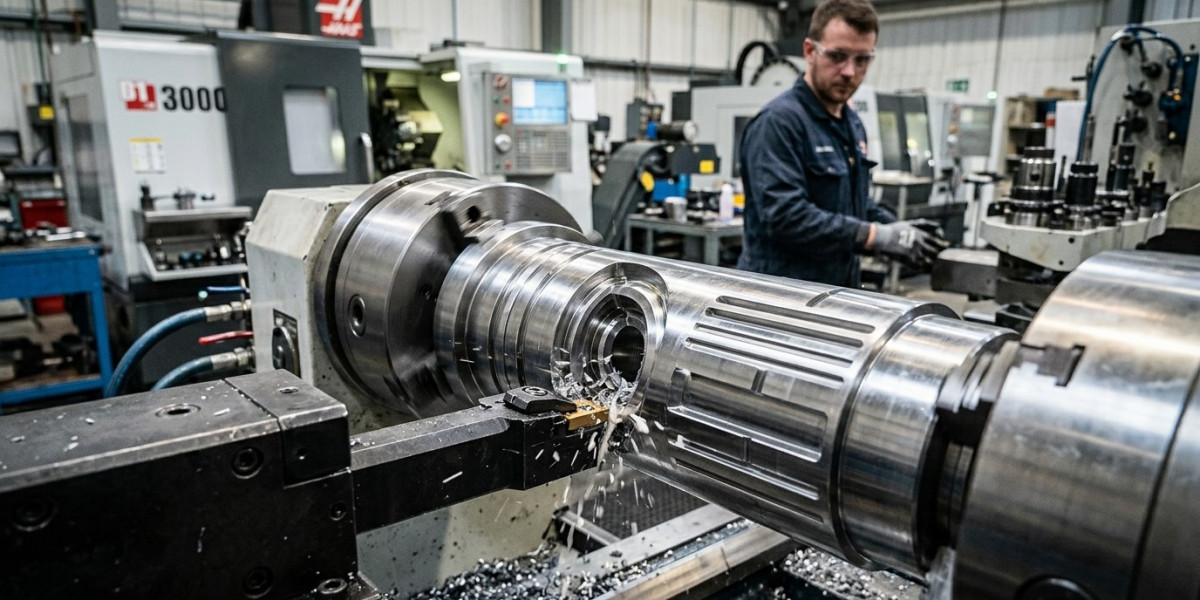

Industrial machining requires specialized tools to create accurate grooves, recesses, channels, and other detailed features on workpieces. Recessing and grooving operations are common in turning, CNC machining, component manufacturing, and precision engineering. Choosing the correct tool can directly affect dimensional accuracy, surface finish, tool life, and production efficiency.
For businesses looking for reliable machining solutions, Khokhawala Trading LLC serves as an experienced Industrial Tools Supplier in Dubai, providing industrial cutting tools, machining accessories, precision measuring tools, and other equipment for engineering and manufacturing applications. Understanding the different types of recessing and grooving tools can help workshops select the right tooling for their specific machining requirements.
What Are Recessing and Grooving Tools?
Recessing and grooving tools are specialized cutting tools designed to remove material from a workpiece to create narrow channels, internal or external grooves, recesses, undercuts, and similar features.
Although the terms are sometimes used interchangeably, the operations can have different purposes. Grooving generally involves producing a narrow channel or groove at a specific location, while recessing can involve removing a larger or more specialized section of material to create clearance, seating areas, or functional profiles.
These operations may be performed on CNC lathes, turning centers, automatic machines, and conventional lathes. The tool must be selected according to the workpiece material, groove dimensions, machining direction, depth, and required finish.
Common Types of Industrial Recessing and Grooving Tools
Different machining applications require different tool designs. Selecting the appropriate tooling helps achieve accurate results while minimizing tool wear and production problems.
1. External Grooving Tools
External grooving tools are used to produce grooves on the outside diameter of cylindrical workpieces. They are commonly used for retaining rings, seals, snap rings, relief grooves, and other component features.
These tools are available in different widths and cutting geometries. The correct width should be selected according to the required groove dimension.
2. Internal Grooving Tools
Internal grooving tools are designed to create grooves inside holes, bores, and other internal features. Because internal machining provides less space for tool clearance and chip evacuation, tool geometry and holder dimensions are particularly important.
Internal grooving tools are commonly used for O-ring grooves, retaining-ring grooves, internal reliefs, and sealing applications.
3. Face Grooving Tools
Face grooving tools create grooves on the face of a component rather than along its external diameter. They are useful when a groove is positioned radially on the front surface of a turned component.
Face grooving often requires specialized tooling because the cutting conditions change as the tool moves toward or away from the center of the workpiece.
4. Parting and Grooving Tools
Parting tools are primarily designed to separate a finished component from bar stock, but many designs can also perform grooving operations.
A suitable combination of parting and grooving capability can reduce the number of tools required in certain machining setups. However, the tool must be selected based on the specific operation and machine capabilities.
5. Profiling and Recessing Tools
Profiling and recessing tools are designed to produce more complex recessed shapes and profiles. They can be used where a standard straight grooving tool cannot create the required geometry.
These tools are particularly useful for specialized components that require controlled radii, angled surfaces, or non-standard recesses.
6. Carbide Grooving Inserts
Indexable carbide inserts are widely used in modern CNC machining because they can provide consistent cutting performance and allow worn cutting edges to be replaced efficiently.
Different carbide grades, coatings, geometries, and insert widths are available for machining materials such as steel, stainless steel, cast iron, and non-ferrous alloys.
Applications of Recessing and Grooving Tools
Grooving and recessing operations are used across many industrial sectors. The exact application depends on the component design and machining requirements.
Common applications include:
- Creating grooves for retaining rings
- Producing O-ring and seal grooves
- Creating thread reliefs
- Producing undercuts
- Preparing components for assembly
- Creating clearance areas
- Machining bearing seats and related features
- Producing decorative or functional grooves
- Parting components from bar stock
- Creating internal grooves in bores
- Manufacturing precision mechanical components
Automotive, aerospace, oil and gas, general engineering, fabrication, machinery manufacturing, and maintenance workshops may all use specialized grooving tools.
How to Choose the Right Grooving or Recessing Tool
Selecting the right industrial cutting tool requires more than simply matching the groove width. Several factors should be considered before making a tooling decision.
1. Consider the Workpiece Material
The material being machined has a major effect on tool selection. Aluminum, mild steel, stainless steel, cast iron, hardened materials, and nickel-based alloys can require different cutting geometries and carbide grades.
For example, stainless steel may generate significant heat and work hardening, while aluminum often requires geometry designed for efficient chip evacuation and reduced material adhesion.
2. Determine the Groove Width and Depth
The required groove dimensions should be established before selecting the tool.
A tool that is too narrow may require multiple passes, increasing machining time. A tool that is too wide may remove excessive material or fail to produce the required profile.
Depth also matters because deeper grooves require adequate tool clearance, rigidity, and chip evacuation.
3. Select the Correct Tool Geometry
Tool geometry affects cutting forces, chip control, surface finish, and tool life.
Consider factors such as:
- Cutting-edge geometry
- Relief angle
- Rake angle
- Insert shape
- Nose radius
- Chip breaker design
- Groove width
- Tool approach direction
The geometry should match the material and machining operation rather than relying on a single general-purpose tool.
4. Choose Carbide Grade and Coating
Carbide tooling is widely used for industrial grooving because it can withstand demanding cutting conditions. However, different carbide grades are optimized for different materials and applications.
Coatings may improve resistance to heat, abrasion, and chemical wear. The correct coating should be selected according to the workpiece material, cutting conditions, and expected production volume.
5. Check Tool Holder Compatibility
A high-quality insert cannot perform effectively if the tool holder is unsuitable. The holder must provide adequate rigidity and maintain the correct tool orientation.
For CNC machining, check the holder dimensions, insert compatibility, machine turret requirements, and required overhang. Excessive tool overhang can increase vibration and reduce machining stability.
This is where appropriate CNC tool holders and machining accessories can make a significant difference to overall performance.
Cutting Parameters for Grooving Operations
Correct cutting parameters are essential for successful grooving and recessing. Cutting speed, feed rate, depth of cut, and coolant application should be selected according to the tool manufacturer's recommendations and the workpiece material.
Cutting Speed
Cutting speed affects heat generation and tool wear. Excessive speed can cause overheating and premature tool degradation, while excessively low speed can reduce productivity and sometimes produce poor cutting conditions.
Feed Rate
Feed rate must be appropriate for the insert geometry and groove dimensions. An excessively high feed can increase cutting forces and cause insert damage, while an excessively low feed may lead to rubbing rather than efficient cutting.
Depth of Cut
Deep grooves should be machined carefully, particularly when the groove width is narrow. Multiple passes may be necessary depending on the tool design, machine rigidity, and workpiece material.
Coolant and Chip Control
Chip evacuation is especially important in deep or internal grooving. Accumulated chips can damage the cutting edge, scratch the machined surface, or interfere with the tool.
Proper coolant application can help control heat and improve chip evacuation when the tooling and workpiece material permit its use.
Common Problems During Grooving and Recessing
Even with quality tooling, machining problems can occur if the setup or cutting parameters are incorrect.
Chatter and Vibration
Vibration can result from excessive tool overhang, inadequate workholding, poor machine rigidity, or unsuitable cutting parameters. It can produce poor surface finish and accelerate tool wear.
Burr Formation
Burrs may occur because of incorrect cutting conditions, worn inserts, unsuitable geometry, or material characteristics. Proper tool selection and controlled cutting parameters can reduce burr formation.
Poor Groove Dimensions
Dimensional inaccuracies may result from tool deflection, insert wear, machine setup errors, or incorrect tool offsets. Precision measuring tools should be used to verify groove width, depth, diameter, and location.
Excessive Tool Wear
High cutting speeds, inadequate coolant, incorrect insert grade, hard workpiece material, and unstable cutting conditions can accelerate tool wear.
Regular inspection and timely tool replacement can help maintain consistent machining quality.
Importance of Precision Measurement After Grooving
Accurate measurement is an important part of any precision machining process. A groove may appear visually correct while still being outside the required dimensional tolerance.
Depending on the component, workshops may use micrometers, vernier calipers, bore gauges, depth gauges, dial indicators, or specialized gauges to verify the finished feature.
Using reliable precision measuring tools helps identify dimensional deviations before components move to subsequent production or assembly stages.
Measurement should ideally be performed under controlled conditions and with properly maintained and verified instruments.
Best Practices for Industrial Grooving and Recessing
Workshops can improve machining consistency by following several basic practices:
- Select the tool according to the material and application.
- Match the insert width to the required groove dimensions.
- Keep tool overhang as short as practical.
- Use rigid workholding and proper tool alignment.
- Follow recommended cutting parameters.
- Ensure adequate chip evacuation.
- Inspect inserts regularly for wear or damage.
- Verify dimensions with suitable measuring equipment.
- Replace worn inserts before they affect component quality.
- Maintain accurate tool offsets and CNC tool data.
Standardizing these practices can reduce setup errors and improve production consistency.
Benefits of Using the Right Grooving Tools
Choosing appropriate industrial grooving and recessing tools provides several operational benefits:
- Improved dimensional accuracy
- Better surface finish
- Reduced tool wear
- More consistent production
- Improved chip control
- Lower risk of insert breakage
- Reduced machining downtime
- Better productivity
- Reliable component quality
- More efficient CNC operations
The right tooling also allows operators to use machine capacity more effectively while maintaining repeatable results across production batches.
Conclusion
Industrial recessing and grooving operations require carefully selected tooling to produce accurate grooves, recesses, undercuts, and specialized component features. Factors such as workpiece material, groove dimensions, tool geometry, carbide grade, coating, tool holding, cutting parameters, and chip evacuation should all be considered before selecting a tool.
For businesses seeking dependable machining and workshop solutions, Khokhawala Trading LLC provides a broad range of industrial cutting tools, CNC machining tools, machining accessories, and precision measuring tools. As an established Industrial Tools Supplier in Dubai, Khokhawala Trading LLC can support engineering workshops, manufacturing companies, CNC machining operations, and industrial businesses with tooling solutions suited to demanding applications.
Choosing the correct grooving tool is not simply about removing material it is about achieving the required dimensions, finish, productivity, and consistency while controlling tool wear and machining costs.