
AI Development Platform: Build Smarter AI Solutions Faster
Artificial intelligence is transforming how businesses build software, automate workflows, and deliver personalized experiences. Whether you're creating a chatbot, recommendation engine, computer vision application, or predictive analytics system, choosing the right AI Development Platform is one of the most important decisions you'll make.
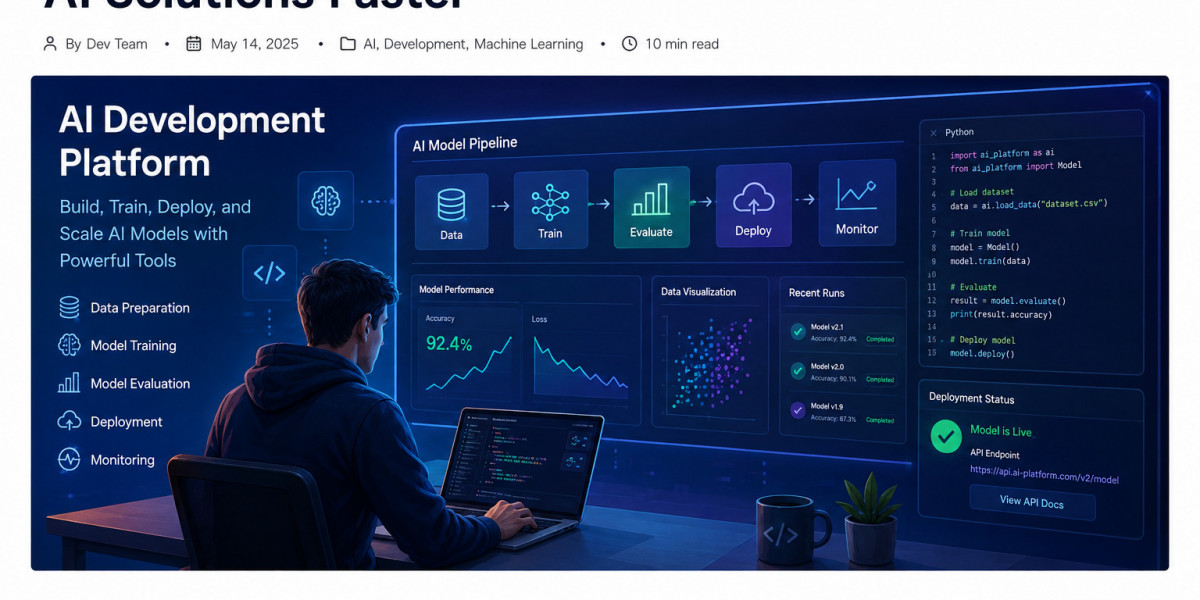
An AI development platform provides developers with the tools, frameworks, infrastructure, and services needed to design, train, test, deploy, and monitor AI models efficiently. Instead of building everything from scratch, developers can use integrated solutions that accelerate development while improving scalability and performance.
In this guide, you'll learn what an AI development platform is, its key features, benefits, and how to choose the best one for your projects.
What Is an AI Development Platform?
An AI Development Platform is a software environment that helps developers create artificial intelligence applications from start to finish. It combines machine learning frameworks, data management tools, model training capabilities, deployment services, APIs, and monitoring features into a single ecosystem.
Modern AI platforms simplify complex development tasks by providing automation, pre-built models, cloud infrastructure, and collaboration tools. This enables development teams to focus more on solving business problems rather than managing infrastructure.
Whether you're an independent developer or part of a large enterprise team, an AI platform can significantly reduce development time and operational costs.
Why Developers Need an AI Development Platform
Developing AI applications involves more than writing code. Teams must collect data, prepare datasets, train machine learning models, evaluate performance, deploy models, and continuously monitor results.
An AI development platform streamlines these processes by offering:
Faster model development
Automated machine learning workflows
Cloud-based training infrastructure
Built-in security
Easy deployment options
Version control for models
Collaboration tools for teams
These capabilities help developers deliver AI-powered applications faster while maintaining quality and reliability.
Key Features of an AI Development Platform
When selecting an AI development platform, consider the following essential features.
1. Machine Learning Framework Support
The platform should support popular frameworks such as TensorFlow, PyTorch, Scikit-learn, and other open-source libraries that developers commonly use.
2. Data Management
High-quality AI depends on quality data. A reliable platform should provide tools for importing, cleaning, labeling, and managing datasets efficiently.
3. Model Training
Look for GPU and distributed computing support to accelerate training for complex machine learning and deep learning models.
4. Automated Machine Learning (AutoML)
AutoML features automate feature engineering, algorithm selection, and hyperparameter tuning, making AI development easier for beginners while saving experienced developers valuable time.
5. Deployment Tools
A good AI platform allows developers to deploy models through REST APIs, cloud services, containers, or edge devices with minimal configuration.
6. Monitoring and Maintenance
AI models require continuous monitoring after deployment. The platform should provide real-time monitoring, logging, performance tracking, and model version management.
Benefits of Using an AI Development Platform
Faster Development
Integrated development tools eliminate repetitive tasks and reduce coding effort, allowing developers to build AI applications more efficiently.
Improved Scalability
Cloud-native AI platforms can easily scale resources based on workload, making them suitable for startups and large enterprises alike.
Lower Infrastructure Costs
Instead of purchasing expensive hardware, developers can leverage cloud-based GPU and CPU resources on demand.
Better Collaboration
Many AI platforms include project sharing, team workspaces, version control, and collaborative notebooks that improve productivity across development teams.
Enhanced Security
Enterprise-grade platforms provide encryption, identity management, compliance features, and secure deployment pipelines to protect sensitive AI workloads.
Popular AI Development Platforms
Several AI development platforms are widely used by developers worldwide.
Some popular options include:
Google Vertex AI
Microsoft Azure AI
Amazon SageMaker
OpenAI API Platform
IBM Watson
DataRobot
Hugging Face
Each platform offers unique capabilities depending on your project requirements, technical expertise, and budget.
How to Choose the Best AI Development Platform
Choosing the right AI development platform depends on several factors.
Project Requirements
Determine whether you're building chatbots, image recognition systems, recommendation engines, predictive analytics, or generative AI applications.
Programming Language Support
Ensure the platform supports languages such as Python, Java, JavaScript, or R based on your development stack.
Integration Options
The platform should integrate seamlessly with your existing databases, cloud services, APIs, DevOps tools, and CI/CD pipelines.
Pricing
Compare free tiers, subscription models, usage-based pricing, and enterprise licensing before making a decision.
Documentation
Comprehensive documentation, tutorials, SDKs, and active developer communities can significantly reduce the learning curve.
Best Practices for AI Development
To maximize success with an AI development platform, follow these best practices:
Start with clean and well-organized datasets.
Continuously evaluate model accuracy.
Monitor deployed models for data drift.
Use version control for datasets and models.
Automate testing before deployment.
Optimize models for speed and scalability.
Protect sensitive data with proper security controls.
Keep AI models updated using new training data.
Following these practices helps maintain high-performing AI applications over time.
Future of AI Development Platforms
AI development platforms continue to evolve rapidly. Future platforms will include more advanced automation, low-code development environments, better explainable AI features, integrated generative AI capabilities, and stronger support for edge computing.
As artificial intelligence becomes more accessible, developers will spend less time managing infrastructure and more time building innovative applications that solve real-world problems.
Organizations investing in modern AI development platforms today will be better positioned to leverage future AI technologies and maintain a competitive advantage.
Conclusion
Selecting the right AI Development Platform can dramatically improve the speed, efficiency, and scalability of AI application development. By offering integrated tools for data preparation, model training, deployment, monitoring, and collaboration, these platforms help developers build intelligent solutions with greater confidence.
Whether you're creating your first machine learning project or deploying enterprise-scale AI systems, investing in a reliable AI development platform will simplify development and accelerate innovation. Evaluate your project requirements carefully, compare available features, and choose a platform that aligns with your long-term goals. With the right tools in place, developers can build smarter AI solutions faster than ever before.