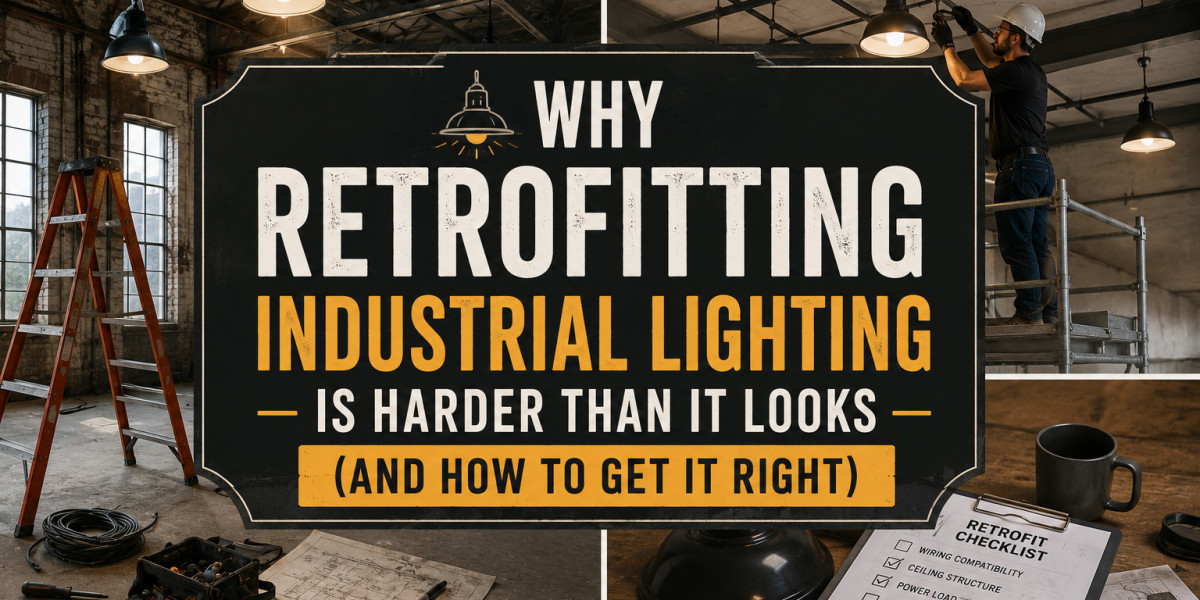

A warehouse manager looks at an electricity bill, does the math, and decides it's time to upgrade the lighting. Metal halide fixtures have been running 24/7 for years, they're dimming, and they cost too much to operate. Time to go LED, right? Call a supplier, order replacements, swap them out, done.
Reality is messier. Industrial and warehouse lighting retrofits fail more often than they succeed, not because the lighting itself is bad, but because the existing fixtures, power systems, and operational requirements don't match what people assume before they start.
Why Old Metal Halide Fixtures Present a Problem
Most warehouses built in the last 20+ years still run on metal halide or high-pressure sodium lighting technology that's reliable but wasteful. Replacing the bulbs with LED alternatives sounds straightforward. In practice, three things go wrong:
Power compatibility issues. A 400W metal halide bulb needs different electrical support than a 60W LED corn light. The ballast, the wiring, the circuit they're all sized for the old load. Swapping bulbs without addressing electrical infrastructure can create safety risks, premature driver failure, or insufficient power delivery.
Fixture design mismatches. Old industrial fixtures were engineered around the heat output and light dispersion of metal halide or sodium lamps. Drop an LED bulb into one without considering optics and you might get uneven light, hotspots, or dark corners where uniform illumination was expected.
Voltage stability concerns. Industrial sites often run on variable voltage three-phase systems, generator backups, utility spikes during peak demand. An LED retrofit bulb that works fine at 120V might struggle at 240V or three-phase power without a driver designed to handle that range.
These aren't theoretical problems. They show up mid-project when a new LED bulb flickers, fails prematurely, or simply doesn't produce the expected light output.
What Actually Works in an Industrial Retrofit
The retrofits that succeed share a few characteristics:
Matched electrical specifications. The LED retrofit bulb supports the voltage range and frequency of the existing circuit. A 100-277V rated bulb works across most North American industrial scenarios residential 120V, commercial 208V three-phase, industrial 240V, high-leg 277V. This flexibility alone solves a massive class of compatibility problems that simpler LED bulbs can't handle.
Sealed, protected drivers. Industrial environments are hostile to electronics. Temperature swings, moisture, dust, electrical noise, power surges all threaten a cheap LED driver. A sealed driver with thermal management and surge protection isn't luxury; it's survival. The difference between a bulb lasting five years and one that fails within 18 months often comes down to whether the internal electronics are protected.
360-degree light distribution. Most industrial fixtures expect omnidirectional light a lamp that glows in every direction so ceiling-mounted reflectors can shape and distribute the light. A directional LED retrofit creates uneven illumination and wasted potential. An omnidirectional corn-style bulb mirrors the light distribution of the original HID lamp, which means the existing reflectors and optics still work as designed.
Sufficient surge protection. Industrial electrical systems experience voltage spikes lightning strikes, motors switching on and off, utility problems, generator transfers. A bulb without proper surge protection fails catastrophically when exposed to that environment. One rated for 6KV surge events shrugs off conditions that would fry a consumer-grade bulb instantly.
The Cost Difference That Matters
A cheap LED corn bulb might cost $30-40. A properly engineered industrial retrofit bulb might cost $100-120. The difference isn't markup; it's engineering.
That premium covers:
A driver sealed against moisture and dust
Capacitors rated for longevity (premium brands like Rubycon) instead of whatever's cheapest
Electrical specifications that actually match industrial environments
Surge protection that holds up under real-world conditions
Passive cooling that doesn't require maintenance
Longer lifespan and lower failure rates that reduce replacement labor
Cheap bulbs replace themselves every 2-3 years and spend maintenance time failing unexpectedly. Well-engineered bulbs last 5+ years and fail predictably at end-of-life rather than mid-project.
For a warehouse running 50 fixtures 24/7, that difference compounds. The "cheaper" bulbs cost dramatically more in total ownership, labor, and downtime.
The Retrofit Checklist Before Ordering
Before committing to any industrial LED retrofit:
Verify voltage. What voltage does the fixture actually receive? Use a meter, don't guess. If the existing circuit runs 277V and the LED bulb only supports up to 240V, you've got a problem before installation starts.
Check the base type. E39 mogul base (the big socket) is standard in commercial and industrial. E26 standard base is residential. Wrong base = expensive mistake. Look at your existing bulb.
Confirm the beam angle. If the original fixture uses omnidirectional light, the retrofit needs to match. A directional LED bulb produces an entirely different light pattern, creating shadows and dark zones.
Understand power draw. A 60W LED drawing power from a 400W circuit is fine. But verify the circuit has capacity for whatever wattage the new fixture draws. Undersized circuits cause problems; oversized circuits are just wasted infrastructure.
Plan for thermal management. Is the fixture enclosed or open? Ventilated or sealed? The thermal environment affects how aggressively the LED bulb needs to cool itself. Passive cooling works in open fixtures; sealed enclosures require active thermal management or higher-grade components.
What an Engineered Industrial Retrofit Looks Like
A bulb specifically designed for industrial retrofit addresses all of these:
Wide voltage input (100-277VAC) covering all standard industrial scenarios
Properly sealed driver protecting electronics from environmental hazards
Premium internal components (Rubycon capacitors, for example) rated for lifespan
Surge protection (6KV+) handling electrical noise and spikes
Omnidirectional light distribution matching the original fixture's optics
Passive cooling without moving parts or maintenance
Full certifications (UL, cUL, ETL, CE, DLC) proving real testing
These specifications aren't marketing. They're answers to specific problems that industrial environments create.
The Bottom Line
Industrial retrofits fail not because LED technology is bad, but because industrial environments demand more than consumer lighting. A warehouse retrofit that prioritizes price over proper engineering becomes a maintenance nightmare that ends up more expensive than doing the job right from the start. The factories and warehouses that get smooth, reliable retrofits are usually the ones that spec bulbs engineered specifically for industrial conditions rather than trying to force consumer-grade LEDs into commercial duty.
For a warehouse or industrial site considering retrofit, this 60W LED corn light with sealed driver and industrial-grade specifications is a solid reference point for what actually works in these environments featuring sealed power management, 6KV surge protection, and a voltage range that covers most North American industrial scenarios without compromise.