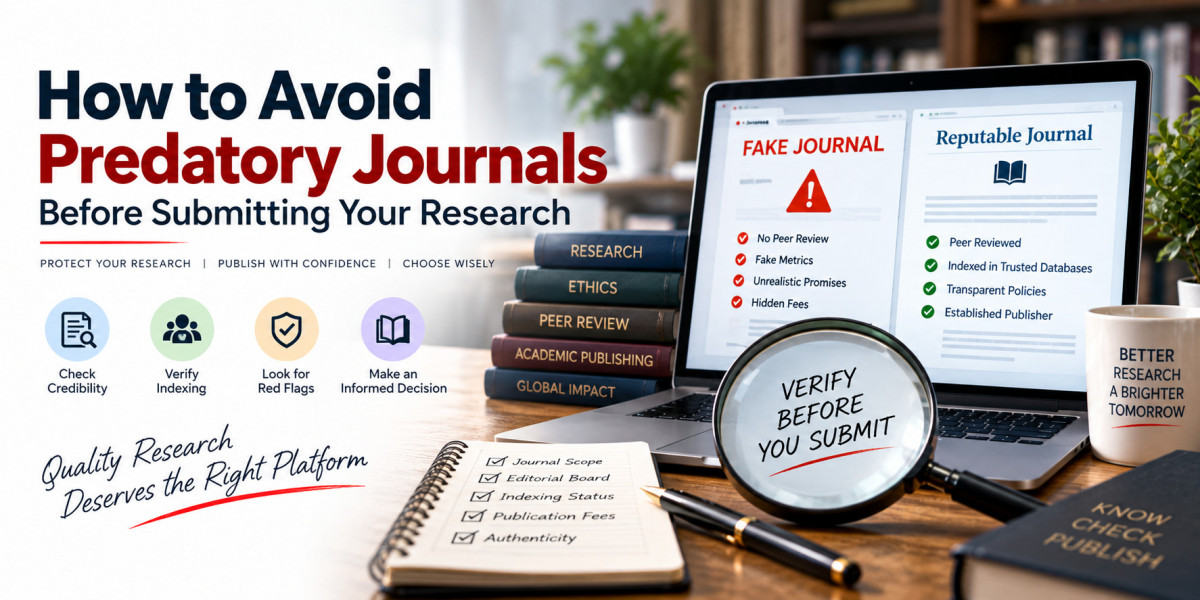

Submitting months or years of research to the wrong journal can cost more than an article processing charge. You may lose time, compromise the visibility of your work, and end up with a publication that your university, funder, or academic committee doesn't recognize.
The safest way to avoid predatory journals is to verify their claims independently before uploading your manuscript or paying any fee. Check the journal's ISSN, publisher identity, editorial board, peer review policy, publication charges, indexing status, and website domain using sources the journal doesn't control.
Don't assume a journal is trustworthy simply because its website looks professional, displays an indexing logo, promises a DOI, or contacts you using academic language. Predatory and hijacked journals increasingly imitate legitimate scholarly publications.
A single warning sign doesn't automatically prove that a journal is predatory. However, several unexplained red flags appearing together should make you stop and investigate further.
This guide gives you a practical verification process you can use before every submission.
Table of Contents
What Is a Predatory Journal?
Why Predatory Journals Are Dangerous
How to Avoid Predatory Journals Before Submission
Predatory Journal Red Flags
How to Verify Journal Indexing
How to Check the Editorial Board
How to Assess Peer Review
How to Spot Fake Impact Factors
How to Identify Hijacked Journals
Are Open Access Journals Predatory?
What If the Journal Is New?
Journal Verification Checklist
What to Do If You've Already Submitted
Frequently Asked Questions
What Is a Predatory Journal?
A predatory journal is generally a deceptive scholarly publication that prioritizes collecting money or manuscripts over providing the editorial, ethical, peer-review, and publishing standards it claims to offer.
The problem isn't simply that a journal charges authors.
Many legitimate open-access journals charge article processing charges, commonly called APCs. The concern arises when a publisher misrepresents its services, hides important information, invents credentials, performs little meaningful peer review, or falsely claims indexing or academic recognition.
Common questionable practices include:
False indexing claims
Misleading journal metrics
Hidden publication charges
Fake or unauthorized editorial board members
Unrealistically broad journal scopes
Guaranteed publication
Little or no meaningful peer review
Misleading journal names
Aggressive unsolicited submission emails
Think. Check. Submit. specifically warns researchers about issues such as false Scopus or DOAJ indexing claims, unofficial impact factors, missing publisher information, hidden fees, suspiciously rapid publication promises, unverifiable editorial boards, and unclear peer-review policies.
Why Should Researchers Avoid Predatory Journals?
Publishing in a questionable journal can create problems long after your manuscript appears online.
Your Work May Not Receive Meaningful Peer Review
Peer review isn't just a formality.
Qualified reviewers can identify weaknesses in methodology, analysis, interpretation, literature coverage, and reporting. A publication that accepts manuscripts without meaningful academic assessment removes an important quality-control stage.
The Publication May Not Meet Institutional Requirements
Your university, funding organization, employer, or academic promotion committee may require publication in journals indexed by a particular database or meeting specific standards.
A journal claiming "Scopus indexed" on its website doesn't prove that it actually has current Scopus coverage.
You need independent verification.
Your Research Reputation Can Be Affected
Researchers are expected to make reasonable decisions about where they publish.
Accidentally publishing in a questionable outlet doesn't automatically define the quality of your research, but repeatedly using journals with clearly problematic publishing practices can raise questions about scholarly judgment.
You Can Lose Money
Some questionable publishers reveal charges only after accepting the manuscript or introduce unexpected processing, formatting, withdrawal, or publication fees.
Transparent journals should clearly explain author fees and when those fees become payable. The Principles of Transparency and Best Practice in Scholarly Publishing emphasize transparency around author fees and other journal policies.
How to Avoid Predatory Journals Before You Submit
Use a verification process instead of trusting one badge, metric, recommendation, or database.
1. Verify the Journal's Exact Identity
Start with:
Full journal name
ISSN/eISSN
Publisher
Official website
Country or organization
Journal scope
Be careful with journal names that sound almost identical to established publications.
A questionable journal may deliberately choose a title that resembles a reputable one.
The Principles of Transparency and Best Practice state that journal names shouldn't be misleading or easily confused with another publication.
2. Verify the ISSN Independently
An ISSN is an identifier for serial publications.
However, simply seeing an ISSN on a journal's website doesn't prove that the website you're viewing actually belongs to that journal.
Verify whether:
The ISSN exists
The journal title matches it
Print and electronic ISSNs are correctly presented
Publisher information is consistent
Think. Check. Submit. specifically recommends checking whether the journal's ISSN is registered rather than relying only on information provided by the journal.
3. Verify Indexing Claims Yourself
Never accept:
"Indexed in Scopus"
"Covered by Web of Science"
"Listed in DOAJ"
simply because the statement appears on the journal's own website.
Check the database directly.
If you specifically need a Scopus-indexed publication, use the site's guide on checking Scopus-indexed journals to understand the verification process before choosing your target journal.
This distinction matters because a journal may have:
Never been indexed
Previously been indexed
Changed its title
Changed its publisher
Had coverage discontinued
Your institution may care about the journal's status at a specific point in time, so verify the current information yourself.
Predatory Journal Red Flags vs Legitimate Journal Signals
Use several indicators together rather than judging a journal on one characteristic.
| Area | Warning Sign | Stronger Trust Signal |
|---|---|---|
| Indexing | Logos or unsupported claims | Status verifiable in the official database |
| ISSN | Missing or inconsistent ISSN | Title and ISSN independently match |
| Editorial board | Names without affiliations | Verifiable researchers and affiliations |
| Peer review | Guaranteed or unexplained instant review | Clearly documented review procedure |
| Fees | Charges appear after submission | Fees disclosed before submission |
| Journal scope | Many unrelated disciplines | Defined scholarly field and readership |
| Ethics | Little or no ethics information | Clear publication ethics policies |
| Metrics | Unknown "impact factor" provider | Metric traceable to its official source |
| Contact details | Generic or unverifiable information | Transparent publisher contact details |
| Website | Imitates another publication | Consistent journal and publisher identity |
One unusual feature doesn't prove misconduct.
A pattern of unverifiable claims is much more important than a single red flag.
How Do You Check a Journal's Editorial Board?
Don't merely confirm that an editorial board page exists.
Verify the people on it.
Select two or three editors and independently search for their:
University profile
Research institute page
ORCID record
Recent publications
Professional research profile
Check whether their specialization makes sense for the journal.
For example, a journal focused on molecular biology should have editors with genuine expertise in relevant biological or biomedical disciplines.
Be cautious if:
Most members have no verifiable affiliation
Experts don't appear to work in the journal's subject area
Names appear without institutional details
An editor appears unaware of being listed
The journal uses impressive titles without verifiable identities
Think. Check. Submit. identifies unverifiable or inappropriate editorial boards as an important warning sign.
How Do You Check a Journal's Peer Review Process?
A legitimate journal should explain how manuscript assessment works.
Look for information about:
Whether articles are peer reviewed
Review model
Who conducts reviews
How editorial decisions are made
Reviewer confidentiality
Revision procedures
Exceptions to normal peer review
The scholarly publishing transparency principles state that journals should clearly describe whether content is peer reviewed, who performs the review, the type of review used, and how manuscript decisions are made.
Is Extremely Fast Peer Review Always Predatory?
No.
Speed alone doesn't prove that a journal is predatory.
An efficiently managed journal may produce decisions quickly, particularly for certain article types.
The concern becomes stronger when rapid publication is combined with:
Guaranteed acceptance
No meaningful reviewer comments
Immediate payment requests
Generic feedback
No described review process
A technically complex study receiving unconditional acceptance almost immediately with no substantive editorial feedback deserves additional scrutiny.
If you aren't familiar with legitimate editorial workflows, reviewing how peer review works before submitting can make suspicious promises much easier to recognize.
How Can You Spot Fake Impact Factors?
The phrase "impact factor" is frequently misused.
Journal Impact Factor (JIF) is a specific journal-level metric associated with Clarivate's Journal Citation Reports.
Scopus, meanwhile, provides metrics such as CiteScore.
A journal displaying something with a similar name doesn't automatically mean it has an official Journal Impact Factor.
Be cautious when you see unfamiliar labels such as:
International Impact Factor
Universal Impact Factor
Global Impact Factor
Scientific Impact Score
Rather than judging the wording alone, determine:
Who publishes the metric?
Is the journal actually listed by that provider?
Can the claimed score be independently verified?
Is the journal implying that an unofficial score is a recognized JIF?
If Journal Impact Factor matters to your publication decision, verify it from the official source rather than copying the figure from the journal's website.
For researchers who need more background, the site's guide explaining journal Impact Factor can help distinguish the metric from other journal indicators.
How Do You Identify a Hijacked Journal?
A hijacked journal creates a particularly difficult problem because the journal itself may be legitimate while the website you're using is fraudulent.
A scammer may imitate:
Journal name
ISSN
Editorial information
Logo
Published articles
Publisher branding
The fake website then collects manuscripts and fees while pretending to represent the real publication.
Think. Check. Submit. specifically warns that hijacked journals can impersonate legitimate journals and may even create similar DOI information.
Use This Verification Chain
Before submitting to an unfamiliar journal:
Find the journal through its publisher rather than through an email link.
Match the journal name and ISSN.
Compare publisher details.
Check the official indexing database.
Compare the database's journal information with the domain you're visiting.
Independently verify contact information.
Investigate unexpected domain or publisher discrepancies.
This is especially important if the journal contacted you first.
Are Unsolicited Journal Emails Always Scams?
No.
Legitimate journals, conference organizers, and special-issue editors sometimes contact researchers.
Instead of treating every invitation as fraudulent, examine how credible and relevant it is.
Be cautious when the email:
Addresses you incorrectly
Praises your research without identifying it
Invites a manuscript far outside your expertise
Promises publication
Creates artificial urgency
Emphasizes payment more than research
Comes from an unrelated generic email address
Contains links to a suspicious domain
Ask yourself:
Why was I specifically invited?
A credible invitation should usually have an academically plausible answer.
Are Open Access Journals Predatory?
No.
Open access and predatory publishing are not the same thing.
Open access describes how readers access published research. Predatory publishing describes deceptive or inadequate publishing behavior.
Many credible open-access journals charge APCs because readers aren't paying subscription fees.
DOAJ evaluates open-access journals against criteria related to transparency, editorial information, publishing practices, journal management, and integrity.
Therefore:
Charging an APC isn't a predatory-journal warning sign by itself.
The important questions are whether the charge is transparent, whether the journal delivers the editorial process it claims to provide, and whether its other credentials can be verified.
What If a Journal Isn't Listed in DOAJ?
Don't immediately label it predatory.
DOAJ specifically focuses on open-access journals. Not every legitimate scholarly journal uses the same publishing model or appears in every directory.
Even among open-access publications, absence from one directory shouldn't be treated as definitive evidence of misconduct.
Instead, examine the complete picture:
Publisher
Journal history
Editorial board
Peer review
Ethics policies
Indexing
Fees
ISSN
Recent articles
Archiving
Licensing
The goal isn't to find one database that makes the decision for you.
The goal is independent verification using multiple signals.
What About New Journals With No Established Metrics?
New doesn't automatically mean predatory.
A legitimate newly launched journal might not yet have:
Citation history
Established metrics
Long publication archives
Coverage in every major database
Focus more heavily on the publisher behind it.
Ask:
Is it operated by a verifiable university?
Is a scholarly society responsible for it?
Does the publisher already operate reputable journals?
Are editors legitimate scholars?
Is the peer-review system documented?
Are fees transparent?
Are publication ethics clear?
A transparent new journal can be legitimate even without an established citation metric.
Conversely, a journal displaying several impressive-looking numbers can still be questionable if none can be verified.
What Publishing Policies Should a Legitimate Journal Show?
Professional journal websites commonly provide clear information about their publishing practices.
Important areas include:
Aims and Scope
You should understand exactly what the journal publishes and for whom.
Peer Review
The process should be described rather than vaguely claiming that articles are "reviewed."
Authorship
The journal should provide policies explaining authorship responsibilities.
Research Misconduct
There should be procedures covering issues such as:
Plagiarism
Data fabrication
Citation manipulation
Conflicts of interest
Ethical oversight
Corrections and Retractions
Readers need to know how errors or misconduct discovered after publication are handled.
Copyright and Licensing
Authors should understand who retains copyright and what license governs published material.
Fees
Any author charges should be easy to identify before submission.
The COPE/DOAJ/OASPA/WAME transparency principles cover precisely these areas, including peer review, licensing, copyright, publication ethics, corrections, retractions, author fees, and ownership.
A 10-Minute Predatory Journal Verification Checklist
Before uploading your manuscript, run through this sequence.
Identity
☐ Journal title appears consistent across independent sources.
☐ ISSN matches the journal.
☐ Publisher identity is clear.
☐ Website appears to belong to the actual publisher.
Indexing
☐ Scopus claims have been checked through Scopus.
☐ Web of Science claims have been independently checked where relevant.
☐ DOAJ claims have been checked directly for open-access journals.
Editorial Quality
☐ Editorial board members can be independently verified.
☐ Their expertise matches the journal.
☐ Peer-review procedures are clearly described.
Transparency
☐ APCs and other author fees are visible before submission.
☐ Copyright and licensing policies are available.
☐ Ethics policies are published.
☐ Retraction and correction procedures are explained.
Content
☐ Recent articles match the journal's stated scope.
☐ Articles appear professionally edited.
☐ Research quality appears appropriate for the discipline.
Final Question
Can I independently verify the journal's most important claims without relying on the journal itself?
If the answer is repeatedly "no," don't submit yet.
What Resources Can Researchers Use to Verify a Journal?
No single resource should act as your entire screening system.
| Resource | Best Use |
|---|---|
| Scopus Sources | Checking Scopus coverage |
| Web of Science resources | Checking relevant WoS coverage |
| DOAJ | Evaluating listed open-access journals |
| ISSN Portal | Confirming journal identity and ISSN |
| COPE | Publication-ethics guidance |
| Think. Check. Submit. | Structured journal evaluation |
| Publisher website | Confirming official policies and journal information |
| Institutional librarian | Independent scholarly publishing advice |
Think. Check. Submit. recommends using a checklist approach and submitting only after you're comfortable that the journal or publisher satisfies the relevant trust checks.
What Should You Do If You're Still Unsure?
Don't rush.
Ask:
Your supervisor
University librarian
Research office
Experienced co-author
Departmental research coordinator
You can also compare the journal with publications regularly cited within your field.
Professional journal-selection support can also help researchers assess scope, indexing, manuscript compatibility, and publication requirements. However, no legitimate support provider should claim control over a journal's independent editorial decision.
If you're preparing your first journal submission, Scopus Journal Publications' journal publication support and research consultancy resources can help you understand the preparation and selection stages before submission.
What If You've Already Submitted to a Suspected Predatory Journal?
Don't panic or immediately submit the same manuscript elsewhere.
Simultaneous submission can create additional publication-ethics problems.
First:
Save copies of all correspondence.
Save the journal's stated fees and policies.
Document your submission date.
Contact your supervisor or institutional research office.
Request withdrawal formally if appropriate.
Keep written evidence of any response.
Don't resubmit elsewhere until the manuscript's status is reasonably clear.
If money has already been requested, avoid making additional payments until you understand the situation.
Your institution's research integrity office or library may be able to advise you based on the journal, publication stage, contracts signed, and disciplinary norms.
Why Journal Selection Matters Beyond Avoiding Predatory Publishers
Journal verification is only half of good journal selection.
A publication can be completely legitimate and still be the wrong venue for your research.
You should also assess:
Subject fit
Research novelty
Article type
Target audience
Journal guidelines
Institutional indexing requirements
Publishing model
Realistic review expectations
The site's guide on how to publish a research paper explains how journal selection fits into the broader manuscript preparation, submission, peer-review, and revision process.
If you're comparing competitiveness as part of your selection process, the journal acceptance rate guide also explains why acceptance rate should be used alongside scope, indexing, editorial transparency, and publication policies rather than as a standalone quality signal.
Final Thoughts
Learning how to avoid predatory journals is less about memorizing a blacklist and more about developing a verification habit.
Before every unfamiliar submission, independently check the journal's identity, ISSN, indexing status, editorial board, peer-review process, publication fees, publishing policies, and domain.
Don't let a polished website, attractive metric, Scopus logo, DOI promise, or flattering email replace verification.
At the same time, avoid assuming that every new journal, open-access journal, APC-charging journal, or fast-review journal is predatory. Evaluate several independent signals together.
If you're unsure where your manuscript belongs, Scopus Journal Publications can support researchers with journal selection, manuscript preparation, research consultancy, and pre-submission guidance while leaving acceptance and editorial decisions with the journal itself.
Frequently Asked Questions
What is the easiest way to identify a predatory journal?
Check whether its major claims can be independently verified. Confirm its ISSN, publisher, indexing, editorial board, peer-review policy, fees, and website identity rather than trusting information displayed only on the journal's own site.
How can I check if a journal is predatory?
There isn't one definitive test. Use several signals together, including indexing verification, ISSN checks, editorial-board verification, transparent fees, peer-review information, publication ethics, and recent article quality.
Can predatory journals claim to be Scopus indexed?
Yes, a questionable journal can display false or outdated indexing claims. Verify current coverage directly through the official Scopus source information rather than relying on a logo or statement on the journal's website.
Are all journals that send invitation emails predatory?
No. Legitimate journals sometimes invite submissions. Be suspicious when the invitation is irrelevant to your expertise, uses excessive flattery, promises acceptance, creates payment pressure, or points to an unverifiable journal.
Are all paid journals predatory?
No. Many legitimate open-access journals charge transparent article processing charges. Hidden fees, deceptive payment requests, or payment combined with guaranteed acceptance are much stronger warning signs.
Is a journal safe if it has an ISSN?
Not necessarily. An ISSN identifies a serial publication; it doesn't independently certify publishing quality or guarantee that the website you're visiting genuinely represents that journal.
Does having a DOI mean a journal is legitimate?
No. A DOI is a persistent identifier for digital content. DOI registration alone isn't proof of rigorous peer review, ethical publishing, appropriate indexing, or overall journal legitimacy.
Is a journal legitimate if it appears in Scopus?
Scopus coverage is an important independent signal when Scopus indexing matters to you, but don't use one criterion alone. Verify the current journal record and also assess editorial transparency, scope, fees, peer review, and publisher identity.
Is Beall's List enough to check predatory journals?
No. Historical lists may provide context, but researchers should use current, independently maintained resources and direct database verification rather than relying on one blacklist.
What should I do if I've already submitted to a predatory journal?
Preserve all correspondence and documents, seek advice from your university's research office or library, and follow an appropriate withdrawal process before sending the same manuscript to another journal.